Uveitis MCQs & Guide
300+ questions with detailed explanations. Master uveitis for FRCOphth, ICO, FAICO, DNB and NEET-SS.
Uveitis overview
Uveitis is a heterogeneous group of inflammatory eye diseases that requires structured anatomical classification (SUN), targeted systemic workup, and a step-wise treatment ladder. It accounts for 10% of legal blindness in working-age adults.
Clinical & exam importance
Uveitis tests pattern recognition heavily. FAICO and DNB practical vivas use clinical photographs of KPs, posterior synechiae and chorioretinal lesions to anchor case discussions.
At a glance
- MCQ bank
- 300+
- Glossary terms
- 14+
- Free sample MCQs
- 15
- Matched products
- 2
Core anatomy & physiology refresher
The foundations you need before tackling clinical and surgical MCQs.
- Uveal tract: iris, ciliary body, choroid.
- Blood–aqueous barrier formed by non-pigmented ciliary epithelium and iris vasculature.
- Blood–retinal barrier formed by RPE tight junctions and retinal vascular endothelium.
- Choroid is the most vascular tissue in the body per unit weight.
- HLA associations: HLA-B27 (acute anterior uveitis), HLA-A29 (birdshot), HLA-B51 (Behçet).
High-yield uveitis facts for MCQs
The facts that appear most often in real exam stems. Learn them cold.
- 1SUN classification by anatomy: anterior, intermediate, posterior, panuveitis.
- 2Acute anterior uveitis (AAU): pain, photophobia, redness, miosis; HLA-B27 in 50%.
- 3HLA-B27 associated systemic diseases: ankylosing spondylitis, reactive arthritis, IBD, psoriatic arthritis.
- 4Fuchs heterochromic iridocyclitis: unilateral, mild inflammation, stellate KPs, heterochromia, cataract; rubella linked.
- 5Pars planitis: intermediate uveitis with vitreous snowballs and inferior snowbanking; MS association.
- 6Toxoplasma retinitis: focal necrotising chorioretinitis adjacent to a pigmented scar; treat with TMP-SMX or pyrimethamine-sulfadiazine.
- 7CMV retinitis: AIDS-defining, pizza-pie appearance, treat with ganciclovir.
- 8Acute retinal necrosis: VZV/HSV, peripheral confluent necrosis; treat with IV aciclovir.
- 9VKH: bilateral panuveitis with neurological and dermatological signs; serous RD on OCT.
- 10Sympathetic ophthalmia: bilateral granulomatous uveitis after penetrating injury or surgery; Dalen-Fuchs nodules.
- 11Behçet disease: occlusive retinal vasculitis, hypopyon uveitis, oral and genital ulcers, pathergy.
- 12Birdshot chorioretinopathy: HLA-A29, cream-coloured deep choroidal lesions, female predominance.
- 13Sarcoid uveitis: mutton-fat KPs, candle-wax dripping, raised ACE; bilateral hilar lymphadenopathy.
- 14Treatment ladder: topical/periocular steroids → systemic steroids → steroid-sparing immunosuppressants → biologics (adalimumab).
- 15Complications of chronic uveitis: cataract, glaucoma, CME, band keratopathy, hypotony.
Related uveitis glossary terms
Exam-ready definitions filtered by subspecialty.
Matched products for Uveitis
Resources hand-picked for this subspecialty.
Or buy the complete bundle for your exam
These exam bundles include uveitis plus all the other topics you need.
General Ophthalmology
A mixed sampler across all ophthalmology subspecialties to test your overall readiness.
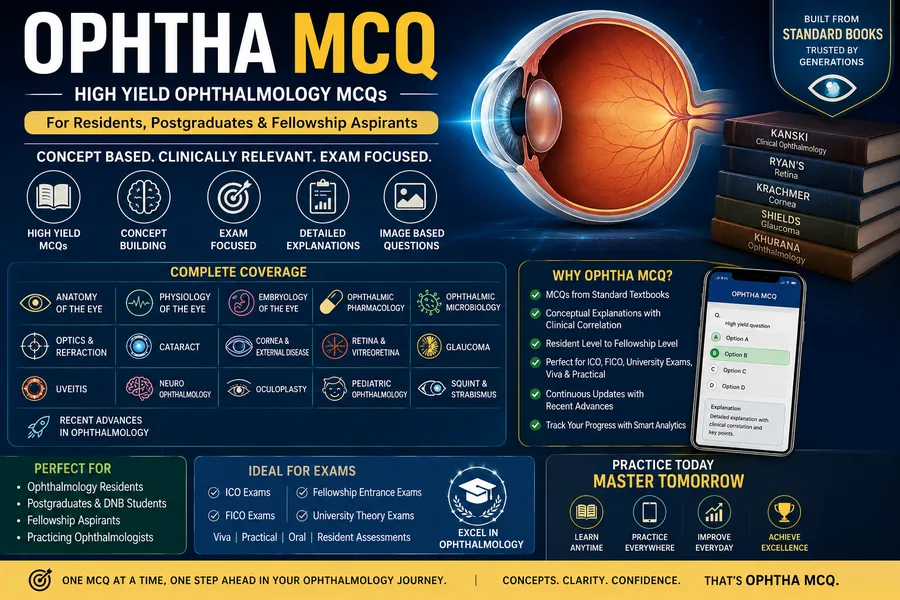
High Yield MCQs
1,000+ high-yield MCQs across all subspecialties with detailed explanations.
Retina Deciphered
150+ pages of handwritten exam-ready notes covering the entire retina syllabus.
Glaucoma Exam Ready Notes
Complete glaucoma notes from pathophysiology to surgical management.
ICO/FICO Past Papers
Last 10 years of ICO/FICO past papers with full explanations and answer keys.
What's Included
- ✓2000+ mixed ophthalmology MCQs
- ✓Cross-topic explanations
- ✓Combined notes and past papers
- ✓Mobile app access
- ✓Lifetime updates
Covered Topics
- ✓Anatomy
- ✓Optics & Refraction
- ✓Cornea
- ✓Lens & Cataract
- ✓Glaucoma
- ✓Retina
Instant access after purchase. Available on Android & iOS app.
Ophthal MCQs High Yield
High-yield MCQ bank across all ophthalmology subspecialties for rapid revision.
High Yield MCQs
1,000+ high-yield MCQs across all subspecialties with detailed explanations.
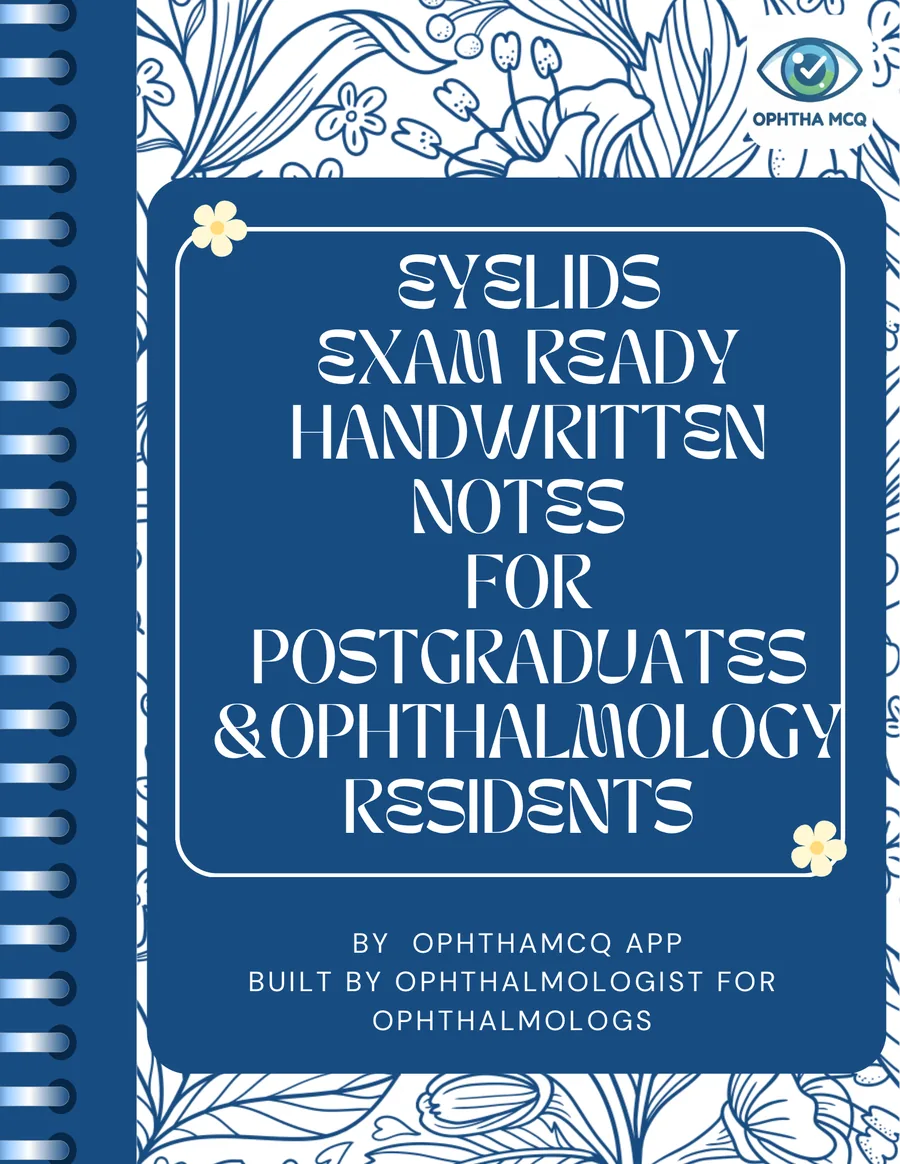
Eyelids Exam Ready Notes
Oculoplastics and eyelid disorders for your PG and fellowship exams.
What's Included
- ✓1000+ high-yield MCQs
- ✓Concise explanations
- ✓Quick revision notes
- ✓Mobile app access
- ✓Lifetime updates
Covered Topics
- ✓Cornea
- ✓Glaucoma
- ✓Retina
- ✓Neuro-Ophthalmology
- ✓Uveitis
- ✓Optics & Refraction
Instant access after purchase. Available on Android & iOS app.
Suggested study sequence
Six phases used by recent passers. Spread across 4–8 weeks per subspecialty.
- 1
1. Anatomical classification
SUN nomenclature and the targeted workup that follows from each compartment.
- 2
2. Anterior uveitis
Acute vs chronic, HLA-B27 spectrum, Fuchs, Posner-Schlossman.
- 3
3. Intermediate uveitis
Pars planitis, sarcoid, multiple sclerosis associations.
- 4
4. Posterior uveitis
Toxoplasma, CMV, ARN, PORN, syphilis, TB, sarcoid.
- 5
5. Panuveitis
VKH, sympathetic ophthalmia, Behçet, sarcoid.
- 6
6. Treatment ladder
Steroids, methotrexate, mycophenolate, anti-TNF biologics.
15 free uveitis MCQs with explanations
Exam-pattern stems with the correct option marked and the reasoning spelled out. Open a question to check your answer.
Q1.Hypopyon uveitis is characteristic of:
Explanation: Hypopyon is classically seen in HLA-B27 acute anterior uveitis and Behçet disease; rarely in infections and endophthalmitis.
Q2.Fuchs heterochromic iridocyclitis is characterised by:
Explanation: Fuchs is a low-grade chronic anterior uveitis classically with heterochromia, fine stellate KPs, absence of posterior synechiae, cataract and secondary glaucoma.
Q3.Mutton-fat keratic precipitates indicate:
Explanation: Large greasy mutton-fat KPs (made of epithelioid cells) signify granulomatous inflammation – sarcoidosis, TB, syphilis, VKH, sympathetic ophthalmia.
Q4.Vogt-Koyanagi-Harada syndrome classically involves:
Explanation: VKH is an autoimmune disease against melanocytes causing bilateral granulomatous panuveitis with exudative RDs, plus auditory, meningeal, integumentary signs.
Q5.Posterior synechiae predispose to:
Explanation: Posterior synechiae block aqueous flow through the pupil leading to iris bombe and secondary angle closure.
Q6.Most common cause of posterior uveitis worldwide:
Explanation: Toxoplasma chorioretinitis is the leading cause of posterior uveitis worldwide; classic appearance is a focal necrotising retinitis adjacent to an old pigmented scar.
Q7.CMV retinitis typically occurs when CD4 count drops below:
Explanation: CMV retinitis is an AIDS-defining illness usually occurring with CD4 < 50/μL.
Q8.Acute retinal necrosis (ARN) is most commonly caused by:
Explanation: ARN is typically due to VZV or HSV, presenting with peripheral necrotising retinitis, retinal vasculitis, vitritis and a high rate of detachment.
Q9.Sympathetic ophthalmia is:
Explanation: Sympathetic ophthalmia is a delayed bilateral granulomatous panuveitis following penetrating injury or intraocular surgery to a fellow ("exciting") eye.
Q10.First-line steroid-sparing agent for chronic non-infectious uveitis:
Explanation: Methotrexate, mycophenolate mofetil and azathioprine are common first-line steroid-sparing immunomodulators in non-infectious uveitis.
Q11.Pars planitis primarily affects:
Explanation: Pars planitis is a chronic intermediate uveitis predominantly in children/young adults with vitreous "snowballs" and inferior snowbanking; associated with MS.
Q12.Most common ocular manifestation of sarcoidosis:
Explanation: Granulomatous anterior uveitis is the commonest ocular involvement in sarcoidosis, often with mutton-fat KPs and iris nodules.
Q13.Behçet disease ocular features include:
Explanation: Behçet causes recurrent attacks of bilateral non-granulomatous panuveitis with occlusive retinal vasculitis and shifting hypopyon.
Q14.Treatment of choice for ocular toxoplasmosis threatening macula:
Explanation: Macula-threatening or vision-threatening lesions require classic triple therapy (pyrimethamine + sulfadiazine + folinic acid) or alternative regimens; corticosteroids added after antimicrobial onset.
Q15.Most useful single investigation in suspected ocular tuberculosis:
Explanation: IGRA (QuantiFERON-TB Gold) is specific for TB infection and unaffected by BCG vaccination; combined with chest imaging and ocular features it supports diagnosis.
Uveitis FAQ
Answers to the questions residents ask most about this topic.
What is the first investigation in newly diagnosed uveitis?
When to start systemic immunosuppression in uveitis?
Adalimumab indications in uveitis?
How to differentiate viral retinitis subtypes?
Best book for uveitis?
Continue your prep
Jump to related exams, topics and resources.
Ready when you are
Your Ophthalmology Exam Is Coming.
Are You Ready?
The world's only ophthalmology PG exam notes and MCQ question bank — built by gold medalists who passed. Start with free sample questions today.