DNB Ophthalmology: Prep Theory & Practicals Together
Ask any DNB ophthalmology resident two months out from their board exams what their study plan looks like, and you'll hear a version of the same answer: "I'm doing MCQs for theory right now. I'll start practical prep after." That split — theory first, practicals later — feels logical. It isn't. It's the single biggest reason residents run out of time, repeat topics twice, and walk into their viva voce underprepared despite months of hard work.
The good news is that DNB ophthalmology theory and practical exam prep together is not just possible, it's faster, more efficient, and better for long-term retention. This guide shows you exactly how to build a unified workflow that covers both papers without doubling your study hours.
The Silo Problem That Fails DNB Residents
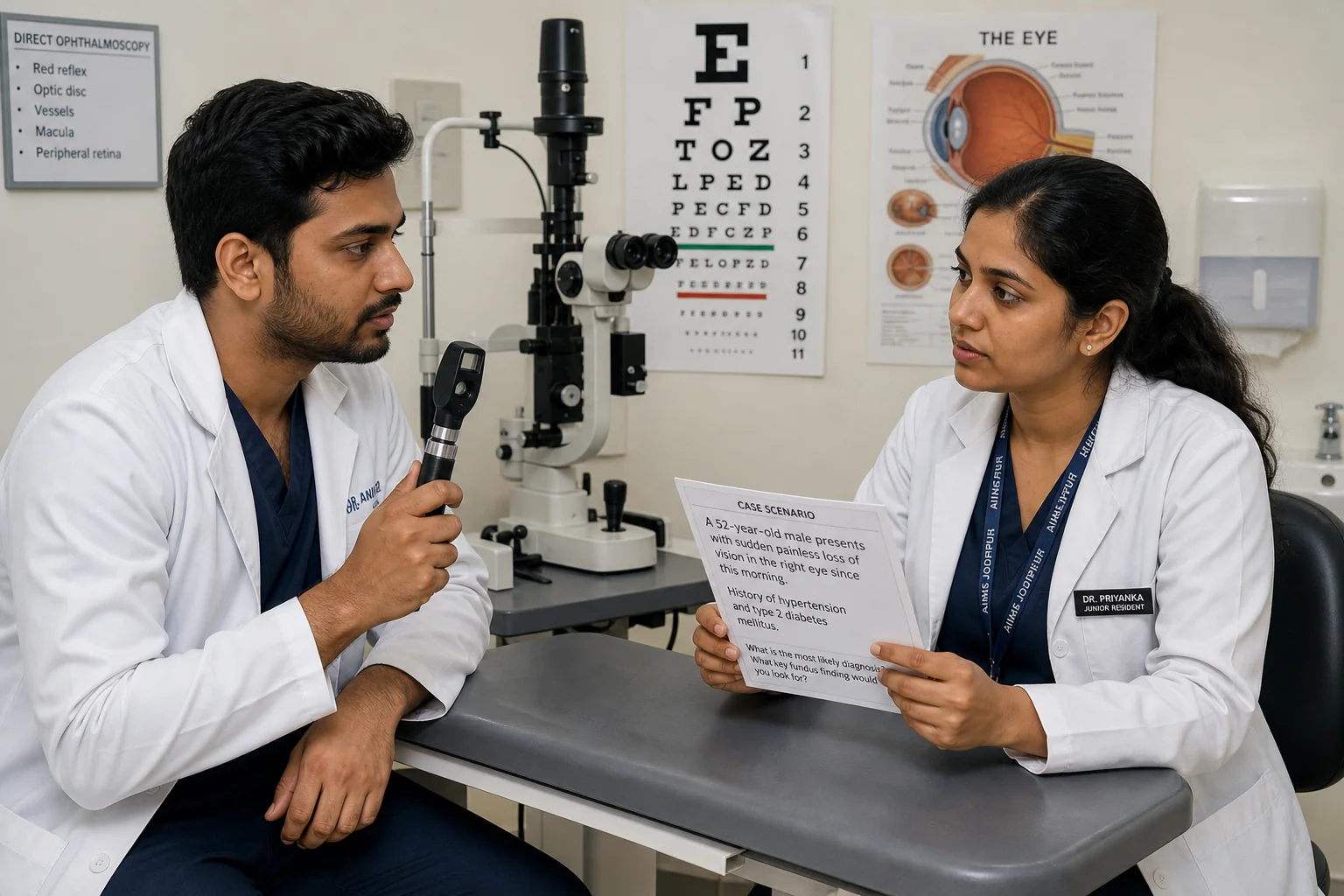
The DNB ophthalmology board exam has two distinct components: a theory paper (MCQ-based) and a practical/clinical examination that includes OSCE stations, instrument identification, case presentations, and a viva voce. Most residents mentally file these as two separate exams requiring two separate preparation tracks.
The result? They spend the first four months grinding MCQs, then panic-cram practical prep into the final three weeks. Topics like slit lamp biomicroscopy, gonioscopy, and indirect ophthalmoscopy get studied twice, once as MCQ theory and again as practical demonstrations, with no connection between the two passes. That's wasted time no resident can afford.
There's a structural reason this happens. Most available resources reinforce the silo. General PG platforms like PrepLadder treat ophthalmology as one subject among dozens, with no practical exam component at all. Textbooks like Kanski and Khurana are written for clinical knowledge, not exam integration. The result is a preparation ecosystem that actively discourages the unified approach.
Breaking out of that silo starts with understanding why the two papers are far more connected than the exam format suggests.
Why Theory and Practicals Overlap More Than You Think
Look at the DNB ophthalmology syllabus carefully and a pattern emerges. The same core topics appear in both the theory MCQ paper and the practical examination, just tested in different formats.
- Instruments: The slit lamp, Goldmann applanation tonometer, indirect ophthalmoscope, Humphrey visual field analyser, and A-scan biometry all appear as MCQ questions (principles, uses, errors) and as practical stations (demonstrate, identify, interpret).
- Clinical cases: A case of primary open-angle glaucoma with disc changes is a classic MCQ stem. It's also a standard OSCE station. The clinical reasoning is identical; only the output format differs.
- Surgical steps: SICS, phacoemulsification, and trabeculectomy steps are asked in theory MCQs (complications, indications, steps in order) and in viva voce (walk me through your surgical approach).
- Subspecialty topics: Retinal detachment, diabetic retinopathy grading, corneal dystrophies, and neuro-ophthalmology findings appear across both papers with high frequency.
Studying these topics once, but in a way that prepares you for both formats, is the core principle of integrated prep. Every hour you spend on a shared topic in an integrated workflow is doing double the work of a siloed approach.
1. Build Your Topic Map Around Shared Concepts
Before you open a single MCQ or pick up a textbook, spend 90 minutes creating a shared topic map. This is your master document for the entire prep cycle.
List every major topic in the DNB ophthalmology syllabus. Then, for each topic, mark two things: does it appear in the theory MCQ paper, and does it have a practical/viva component? Most topics will have both. A few (pure pharmacology calculations, for example) will be theory-only. A handful (surgical knot tying, wet lab skills) will be practical-only.
Group your shared topics by subspecialty:
- Anterior segment: Cornea, lens, cataract surgery, anterior chamber, iris
- Glaucoma: Tonometry, gonioscopy, optic disc assessment, visual fields, surgical options
- Posterior segment: Retinal detachment, diabetic retinopathy, AMD, vitreoretinal surgery
- Neuro-ophthalmology: Pupil pathways, visual field defects, cranial nerve palsies
- Oculoplastics and orbit: Lid anatomy, ptosis, orbital fractures, lacrimal system
- Instruments and investigations: All major ophthalmic instruments and imaging modalities
This map becomes the backbone of your weekly schedule. Every study block you plan should be anchored to one subspecialty group, covering both its MCQ content and its practical implications in the same week.
2. Use MCQ Practice to Identify Practical Weak Spots
Your MCQ bank is not just a theory tool. Used correctly, it's one of the most efficient ways to surface your practical exam gaps.
Here's the mechanism: when you get an MCQ wrong on a topic like Goldmann three-mirror lens or Humphrey visual field patterns, that wrong answer is a signal. It tells you that your understanding of that topic is shallow, shallow enough that you'd struggle to answer a viva question on it too. Flag every instrument-related, clinical sign-related, or surgical step-related wrong answer as a dual-flag item: it needs MCQ review AND practical prep attention.
The quality of your MCQ bank matters enormously here. A question bank built by practising ophthalmologists, not generalists or AI, will include explanations that contain the exact clinical detail examiners probe in viva voce. When an explanation tells you why Goldmann applanation tonometry overestimates IOP in thick corneas, that's not just an MCQ fact. It's a viva answer waiting to happen.
OphthaMCQ's bank of 20,000+ questions is mapped specifically to the DNB/MS/DO syllabus and built by ophthalmologists who have personally sat these exams. The explanations are written to the depth that viva examiners actually probe, not the surface-level recall that generic platforms provide. Try 200 free MCQs to see the difference in explanation quality before committing to a full subscription.
For a deeper look at how to get the most out of an MCQ bank as a study tool, see our guide on how to use an MCQ bank for ophthalmology PG exams.
3. Anchor Your Notes to Both Exam Formats
Standard revision notes are written for one purpose: theory recall. You read them, you remember facts, you answer MCQs. That's useful, but it's only half the job for DNB candidates.
Exam-ready notes should serve double duty. For every clinical topic, your notes need to contain both the MCQ-testable facts (mechanisms, classifications, statistics) and the viva-ready talking points (how you'd present a case, what you'd examine, what your management plan would be).
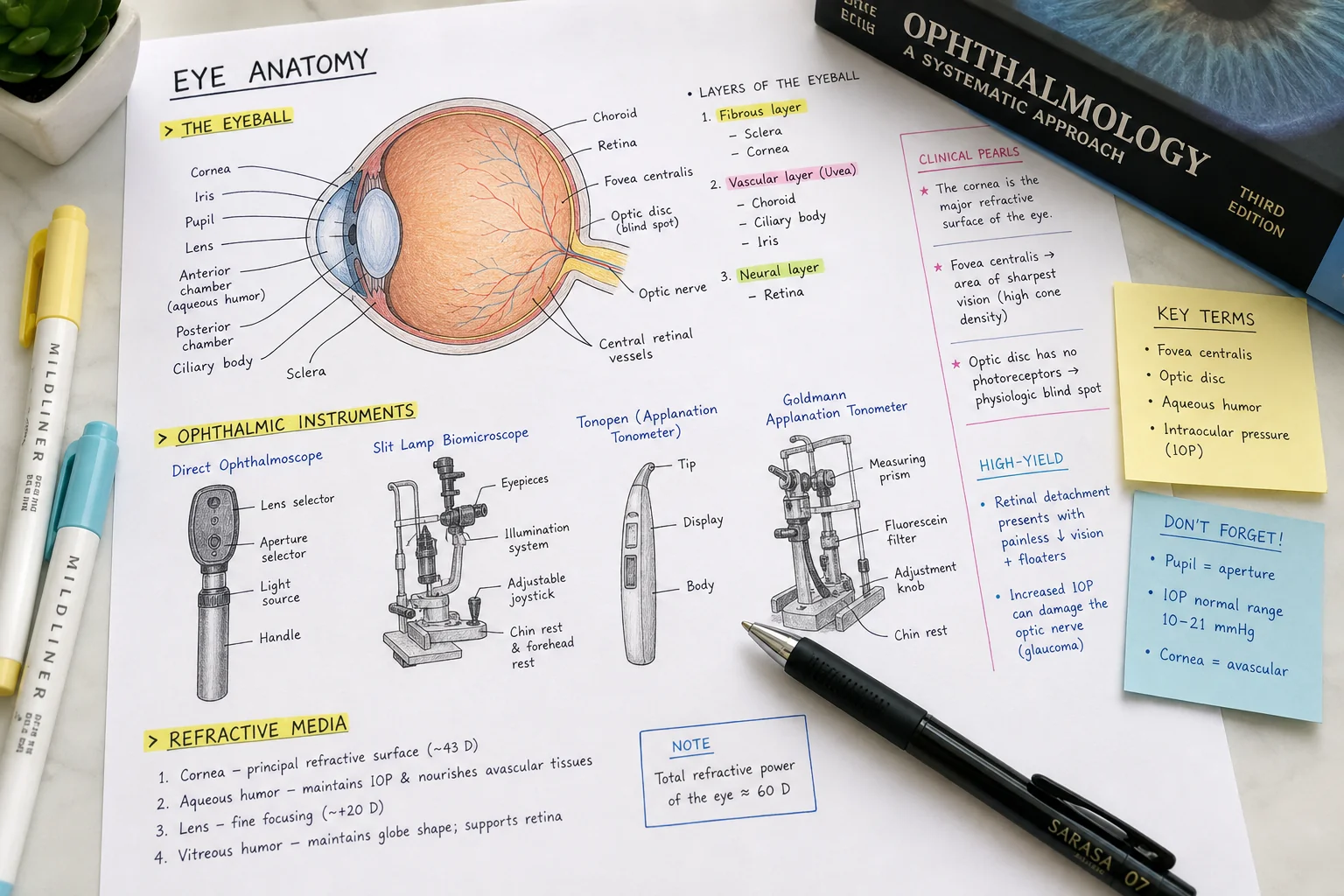
One practical technique: add a narrow margin column to your notes labelled "Viva Angle." For each topic, write one or two bullet points in that column that answer the question: "What would an examiner ask me to demonstrate or explain about this in a clinical setting?" This small addition transforms a theory-only resource into a dual-format study tool.
OphthaMCQ's handwritten exam-ready notes are distilled from standard ophthalmology textbooks, Kanski, Khurana, BCSC, Elkington, and structured specifically for exam performance, not clinical reference. They cover both the factual depth needed for theory MCQs and the clinical framing needed for practical exams.
The notes available at ophthamcq.org/notes include subspecialty-specific modules that are particularly valuable for integrated prep:
- Glaucoma Notes: Covers tonometry principles, gonioscopy findings, optic disc grading, and surgical options, all high-yield for both theory MCQs and practical stations.
- Retina & Vitreous Notes: Includes retinal detachment classification, diabetic retinopathy grading scales, and laser parameters, topics that appear in both MCQ stems and OSCE fundus photograph stations.
- Anterior Segment Notes: Covers corneal anatomy, cataract surgical steps, IOL calculations, and anterior chamber angle anatomy, directly relevant to both written and clinical exams.
- Instruments & Investigations Notes: A dedicated module on ophthalmic instruments, their principles, uses, and clinical interpretation, the single most cross-format topic in the entire DNB syllabus.
- Neuro-Ophthalmology Notes: Pupil pathways, visual field defects, and cranial nerve palsies presented in a format that works for both MCQ pattern recognition and viva case discussion.
Rather than re-reading 900-page textbooks separately for theory and practical prep, these notes give you a single, exam-calibrated resource that covers both. Browse the full notes library to see which modules are available for your exam stage.
4. Schedule Theory and Practical Blocks in the Same Week
The most common scheduling mistake is deferring all practical prep to the final two to three weeks before the exam. By that point, you're trying to learn instrument handling, OSCE station structure, and viva presentation skills simultaneously, under maximum stress, with minimum time.
The fix is straightforward: schedule theory and practical blocks on the same subspecialty in the same week. Here's what a sample weekly schedule looks like for a resident with a full clinical load:
- Monday, Tuesday: MCQ practice on glaucoma (50, 70 questions, timed). Review wrong answers and flag dual-flag items.
- Wednesday: Review glaucoma notes, both MCQ facts and viva-angle margin notes. Revise tonometry, gonioscopy, and disc grading.
- Thursday: Practical prep on glaucoma, practice describing a glaucomatous disc, walk through a gonioscopy interpretation, rehearse your surgical approach to trabeculectomy verbally.
- Friday: Mixed review, 20 glaucoma MCQs + one mock viva question answered aloud. Identify remaining gaps.
- Weekend: Move to the next subspecialty. Repeat the cycle.
This structure means that by the time you've cycled through all subspecialties, you've done both theory and practical prep for each one. Nothing gets left to the last minute.
OphthaMCQ's mobile app (available on Android and iOS) makes this schedule practical for residents with unpredictable clinical hours. MCQ practice during a quiet outpatient slot, notes review on the commute home, and a quick viva rehearsal in the evening, the platform is built for exactly this kind of fragmented but consistent study pattern.
5. Practice OSCE Stations Using MCQ Case Stems
Here's a technique that most residents overlook: MCQ case stems are structurally identical to OSCE station scenarios.
A well-written MCQ case stem presents a patient's age, presenting complaint, clinical findings, and investigation results, then asks you to identify the diagnosis or next step. An OSCE station does exactly the same thing, except instead of choosing from four options, you're expected to verbalise your reasoning.
Use this overlap deliberately. When you finish a set of case-based MCQs, pick three or four of the most clinically rich stems and treat them as OSCE practice prompts. Cover the answer options. Read the stem aloud to a study partner (or to yourself). Then walk through:
- What are the key clinical findings in this case?
- What is your differential diagnosis?
- What investigations would you order and why?
- What is your management plan?
This exercise takes 10, 15 minutes per case and builds exactly the structured clinical reasoning that OSCE examiners are looking for. It also reinforces the MCQ content far more deeply than passive re-reading.
OphthaMCQ's OSCE, Practical & Viva Voce Ready Bundle takes this further with structured station-by-station preparation material built specifically for DNB/MS/DO practical exams. It's the only platform that covers both the theory MCQ bank and the practical exam component in a single integrated resource. Browse the full Notes & MCQ bundle to see how the practical prep component is structured.
6. Use Viva Voce Prep to Deepen MCQ Accuracy
The relationship between viva prep and MCQ performance runs in both directions. Just as MCQ practice surfaces practical gaps, viva preparation deepens your theory accuracy in ways that passive reading cannot.
When you prepare to answer a viva question, "Describe the mechanism of action of latanoprost" or "Walk me through the steps of a SICS", you're forced to organise your knowledge into a coherent, sequential explanation. That process of articulation exposes gaps that multiple-choice practice hides. You might be able to identify the correct MCQ answer about prostaglandin analogues without being able to explain the mechanism clearly. Viva prep closes that gap.
Practically, this means:
- After reviewing a topic in your notes, close the notes and explain the topic aloud as if you're answering a viva question.
- Record yourself on your phone for 60, 90 seconds. Play it back. Identify where you hesitated or lost structure.
- Return to the MCQ bank and attempt 10, 15 questions on that topic immediately after. You'll notice your accuracy improves, because you now understand the concept, not just recognise the answer.
This verbal rehearsal technique is particularly effective for high-yield topics that appear heavily in both papers: surgical complications, drug mechanisms, instrument principles, and clinical grading scales.
7. Track Progress Across Both Formats Together
Most residents track their MCQ performance (percentage correct, topics attempted) but have no equivalent system for practical readiness. This asymmetry means practical gaps stay invisible until the exam itself.
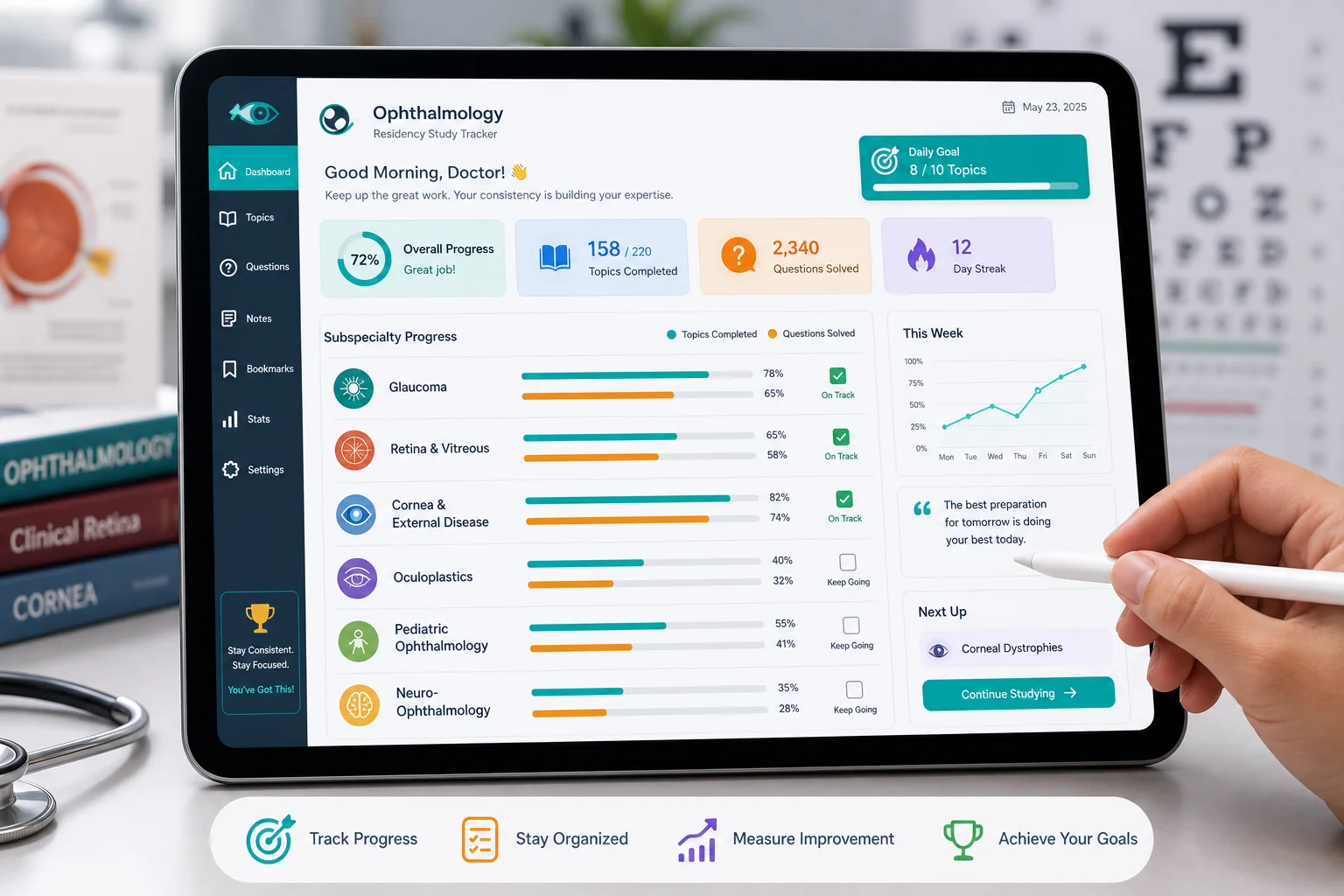
Build a dual-format progress tracker. A simple spreadsheet works well. List every major topic in one column. Add two rating columns: MCQ Confidence (1, 5) and Viva/Practical Readiness (1, 5). Update both ratings after each study block.
The tracker will quickly reveal patterns:
- Topics where MCQ confidence is high but practical readiness is low (common for instrument-heavy topics studied only from textbooks)
- Topics where practical readiness is high (from clinical exposure) but MCQ accuracy is low (because the underlying theory hasn't been formalised)
- Topics where both scores are low, your highest-priority study targets
OphthaMCQ's platform automatically tracks your MCQ performance by topic and subspecialty, giving you the theory side of this tracker built in. Pair that data with your own viva readiness ratings and you have a complete picture of where you stand across both exam formats at any point in your prep cycle.
For residents who want to see how their exam-specific performance compares to the DNB syllabus structure, browse by exam on OphthaMCQ to see how the question bank is mapped to the DNB/MS/DO syllabus specifically.
Frequently Asked Questions
How early should I start integrated prep for DNB ophthalmology?
Start the integrated approach from the beginning of your dedicated exam prep period, ideally six to nine months before your theory paper. The earlier you integrate, the more cycles you can complete through the full subspecialty map. Residents who start integrated prep late (within two months of the exam) often find they don't have enough time to cover practical components adequately.
Can I use the same notes for theory and practical exams?
Yes, provided the notes are structured for both formats. Generic textbook summaries are written for clinical knowledge, not exam performance. OphthaMCQ's handwritten exam-ready notes are specifically structured to cover both the factual depth needed for theory MCQs and the clinical framing needed for practical exams. The instruments and investigations module, in particular, is designed to serve both formats directly. Explore the notes modules to find the ones most relevant to your current study block.
How many MCQs should I do per day alongside practical prep?
For residents with a full clinical schedule, 40, 60 MCQs per day is a sustainable target that leaves time for practical prep in the same session. Quality matters more than volume: 50 well-reviewed questions with careful explanation reading will outperform 150 questions answered and forgotten. On days when you're doing active practical prep (instrument practice, mock viva), reduce MCQ volume to 20, 30 and focus on the same subspecialty topic.
Does OphthaMCQ cover the practical/viva component of DNB exams?
Yes. OphthaMCQ offers a dedicated OSCE, Practical & Viva Voce Ready Bundle for DNB/MS/DO candidates, alongside the main MCQ bank and handwritten notes. This makes it the only platform that covers all three components of DNB ophthalmology exam preparation, theory MCQs, written notes, and practical/viva prep, in a single integrated resource. Browse the full product range to see how the components fit together.
What if I'm not sure which OphthaMCQ plan is right for my exam stage?
OphthaMCQ covers multiple exam formats including DNB/MS/DO, ICO/FICO, FAICO, and FRCOphth. If you're unsure which bundle matches your current exam, contact the team directly, the platform is built by practising ophthalmologists who can advise on the right preparation path for your specific exam and timeline.
Start Prepping Both Papers at Once
The residents who perform best in DNB ophthalmology board exams are not the ones who studied the most hours. They're the ones who studied the right topics in the right way, covering theory and practical components together, reinforcing each with the other, and never leaving practical prep to the last minute.
The integrated workflow in this guide works because it reflects how the exam actually tests you: the same concepts, in two different formats, on two different days. Study them together and you prepare for both simultaneously.
OphthaMCQ is built specifically for this approach. The 20,000+ question bank, handwritten exam-ready notes, and OSCE/Viva Voce bundle are designed to work as a single system, not three separate resources. Every question explanation is written to the depth that viva examiners probe. Every notes module covers both MCQ facts and clinical framing. The platform is built by ophthalmologists who passed these exact exams, including gold medalists and exam toppers who know precisely what the DNB board tests.
If you're ready to move away from siloed prep and build a workflow that covers both papers efficiently, start with the free trial. Try 200 free MCQs to experience the explanation quality firsthand, then browse the full Notes & MCQ bundles to find the integrated package that fits your exam timeline.
Ready to apply what you learned?
Practice 10,000+ MCQs with detailed explanations and track your progress.
Start Free Practice