Cataract MCQs & Guide
400+ questions with detailed explanations. Master cataract for FRCOphth, ICO, FAICO, DNB and NEET-SS.
Cataract overview
Cataract is the world’s leading cause of reversible blindness and the most performed ophthalmic surgery globally. The topic spans lens biology, biometry, phacoemulsification technique, IOL design and complication management.
Clinical & exam importance
Cataract questions reliably appear across every PG exam, weighted 8–12%. PD-CET and DNB practical vivas test surgical decision-making in detail. FAICO cataract candidates must master complex cataract surgery.
At a glance
- MCQ bank
- 400+
- Glossary terms
- 10+
- Free sample MCQs
- 3
- Matched products
- 3
Core anatomy & physiology refresher
The foundations you need before tackling clinical and surgical MCQs.
- Lens grows throughout life with new fibres added peripherally; nucleus compacts centrally.
- Lens capsule is the basement membrane of the lens epithelium; anterior thicker than posterior.
- Zonules originate from the pars plana and pars plicata and insert pre- and post-equatorially.
- Aqueous humour provides nutrition; lens is avascular.
- Lens biochemistry: 35% protein (crystallins), highest of any body tissue.
High-yield cataract facts for MCQs
The facts that appear most often in real exam stems. Learn them cold.
- 1Age-related cataract types: nuclear sclerotic, cortical, posterior subcapsular.
- 2PSC cataract: glare, near vision affected first; associated with steroids and diabetes.
- 3Congenital cataract bilateral: TORCH, galactosaemia, Lowe syndrome, myotonic dystrophy.
- 4Christmas tree cataract: myotonic dystrophy.
- 5Sunflower cataract: Wilson disease.
- 6IOL formulas: SRK/T, Hoffer Q, Haigis, Holladay for normal eyes; Barrett Universal II and Hill-RBF for outliers.
- 7Short eye (<22 mm): use Hoffer Q or Haigis. Long eye (>26 mm): use SRK/T or Barrett.
- 8Phaco fluidics: bottle height, aspiration flow rate and vacuum determine chamber stability.
- 9Posterior capsular rupture: convert to anterior vitrectomy; assess for vitreous prolapse, sulcus IOL if adequate support.
- 10Endophthalmitis: most common organism is Staph epidermidis. Treat per EVS: vitreous tap and intravitreal vancomycin + ceftazidime.
- 11PCO: most common late complication; treat with YAG capsulotomy.
- 12CME after surgery (Irvine-Gass): peak at 4–6 weeks; treat with topical NSAID and steroid.
- 13TASS: toxic anterior segment syndrome, sterile inflammation within 24h; differential of endophthalmitis.
- 14Posterior polar cataract: high risk of PCR; use slow-mo phaco, viscoexpression, avoid hydrodissection.
- 15Multifocal IOLs: night vision symptoms (glare, halos); avoid in macular disease and demanding visual tasks.
Related cataract glossary terms
Exam-ready definitions filtered by subspecialty.
Matched products for Cataract
Resources hand-picked for this subspecialty.
High Yield MCQs
1,000+ high-yield MCQs across all subspecialties with detailed explanations.
Anatomy of Eye Notes
Complete ocular anatomy with clinical correlations and exam focus.
Optics & Refraction Notes
The most feared topic — made simple with diagrams and solved problems.
Or buy the complete bundle for your exam
These exam bundles include cataract plus all the other topics you need.
General Ophthalmology
A mixed sampler across all ophthalmology subspecialties to test your overall readiness.
High Yield MCQs
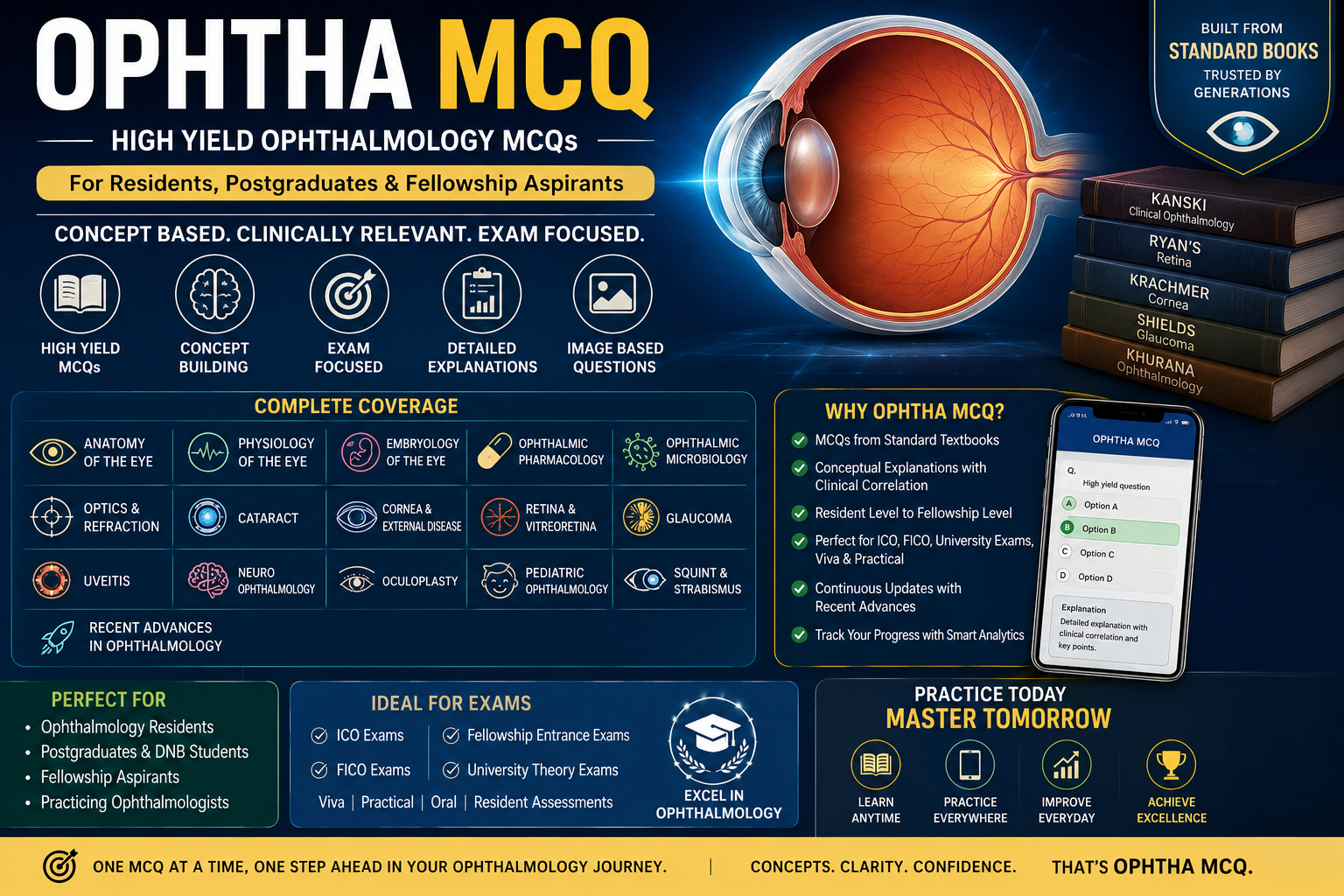
1,000+ high-yield MCQs across all subspecialties with detailed explanations.
Retina Deciphered
150+ pages of handwritten exam-ready notes covering the entire retina syllabus.
Glaucoma Exam Ready Notes
Complete glaucoma notes from pathophysiology to surgical management.
ICO/FICO Past Papers
Last 10 years of ICO/FICO past papers with full explanations and answer keys.
What's Included
- ✓2000+ mixed ophthalmology MCQs
- ✓Cross-topic explanations
- ✓Combined notes and past papers
- ✓Mobile app access
- ✓Lifetime updates
Covered Topics
- ✓Anatomy
- ✓Optics & Refraction
- ✓Cornea
- ✓Lens & Cataract
- ✓Glaucoma
- ✓Retina
Instant access after purchase. Available on Android & iOS app.
Ophthal MCQs High Yield
High-yield MCQ bank across all ophthalmology subspecialties for rapid revision.
High Yield MCQs
1,000+ high-yield MCQs across all subspecialties with detailed explanations.
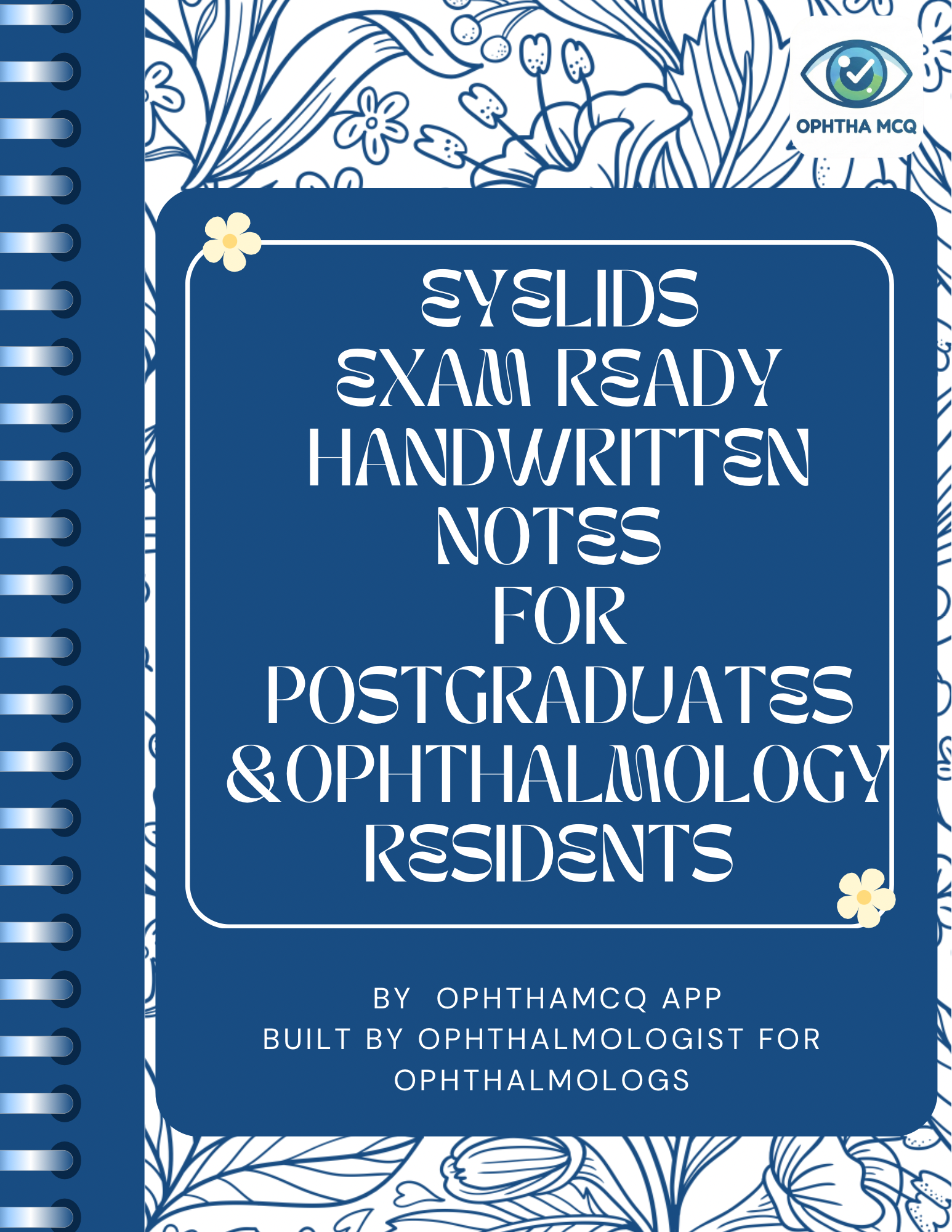
Eyelids Exam Ready Notes
Oculoplastics and eyelid disorders for your PG and fellowship exams.
What's Included
- ✓1000+ high-yield MCQs
- ✓Concise explanations
- ✓Quick revision notes
- ✓Mobile app access
- ✓Lifetime updates
Covered Topics
- ✓Cornea
- ✓Glaucoma
- ✓Retina
- ✓Neuro-Ophthalmology
- ✓Uveitis
- ✓Optics & Refraction
Instant access after purchase. Available on Android & iOS app.
Suggested study sequence
Six phases used by recent passers. Spread across 4–8 weeks per subspecialty.
- 1
1. Lens biology
Embryology, anatomy, physiology, biochemistry of crystallins.
- 2
2. Cataract classification
Age-related, congenital, traumatic, secondary, metabolic.
- 3
3. Biometry and IOL selection
Axial length, K readings, formulas, special situations.
- 4
4. Phacoemulsification
Steps, fluidics, machine settings, divide-and-conquer vs phaco chop.
- 5
5. Complications
PCR, dropped nucleus, suprachoroidal haemorrhage, endophthalmitis, CME.
- 6
6. Special situations
Subluxated lens, posterior polar, white cataract, post-vitrectomy eye.
Free cataract sample MCQs
A taste of the exam-style stems from the full bank.
Q1.Posterior subcapsular cataract is MOST classically associated with:
Explanation: PSC is the hallmark of chronic systemic or topical steroid therapy; it also occurs with radiation, uveitis, and high myopia.
Q2."Christmas tree" cataract is characteristic of:
Explanation: Polychromatic iridescent crystals in the cortex ("Christmas tree" cataract) are characteristic of myotonic dystrophy.
Q3.In sunflower cataract, the deposited substance is:
Explanation: Sunflower cataract is copper deposition under the anterior lens capsule in Wilson's disease or chalcosis.
Cataract FAQ
Answers to the questions residents ask most about this topic.
Best IOL formula for short eyes?
How do I manage posterior capsular rupture intraoperatively?
When is YAG capsulotomy indicated?
Multifocal IOL contraindications?
What is the role of femtosecond laser in cataract surgery?
Continue your prep
Jump to related exams, topics and resources.
Ready when you are
Your Ophthalmology Exam Is Coming.
Are You Ready?
The world's only ophthalmology PG exam notes and MCQ question bank — built by gold medalists who passed. Start with free sample questions today.