Glaucoma MCQs & Guide
500+ questions with detailed explanations. Master glaucoma for FRCOphth, ICO, FAICO, DNB and NEET-SS.
Glaucoma overview
Glaucoma is a group of optic neuropathies characterised by progressive retinal ganglion cell loss, optic disc cupping and visual field defects, usually but not always associated with raised intraocular pressure (IOP). It is the second leading cause of irreversible blindness worldwide.
Clinical & exam importance
Glaucoma carries the highest weighting after retina across most ophthalmology exams — typically 12–18% of MCQs. Surgical decision-making (trabeculectomy vs tube vs MIGS) and field interpretation dominate viva questions in FAICO and DNB practicals.
At a glance
- MCQ bank
- 500+
- Glossary terms
- 14+
- Free sample MCQs
- 3
- Matched products
- 2
Core anatomy & physiology refresher
The foundations you need before tackling clinical and surgical MCQs.
- Aqueous humour is secreted by the non-pigmented ciliary epithelium (pars plicata) at 2–3 µL/min.
- Drainage: 80–90% via the trabecular meshwork into Schlemm canal, 10–20% via the uveoscleral pathway.
- Trabecular meshwork has three layers: uveal, corneoscleral and juxtacanalicular (greatest outflow resistance).
- Normal IOP range is 10–21 mmHg with diurnal variation up to 4–5 mmHg.
- Optic nerve head has ~1.2 million axons converging through the lamina cribrosa.
High-yield glaucoma facts for MCQs
The facts that appear most often in real exam stems. Learn them cold.
- 1Primary open angle glaucoma (POAG) is the most common adult glaucoma worldwide.
- 2First-line medical therapy is a prostaglandin analogue (latanoprost, travoprost, bimatoprost).
- 3Risk factors for POAG: raised IOP, family history, African ancestry, age, thin central cornea, myopia.
- 4CCT correction: thin cornea underestimates true IOP; thick cornea overestimates.
- 5Angle closure: pupillary block (most common), plateau iris, phacomorphic, malignant glaucoma.
- 6Acute angle closure attack: pain, headache, nausea, halos, mid-dilated fixed pupil, IOP often 40–80 mmHg.
- 7Acute treatment: IV acetazolamide, topical beta-blocker, alpha agonist and pilocarpine after IOP drops, then YAG PI.
- 8Normal tension glaucoma: progressive optic neuropathy with IOP consistently <21 mmHg; consider migraine and vasospasm.
- 9Pseudoexfoliation: dandruff-like material on lens; high IOP spikes; often unilateral or asymmetric.
- 10Pigmentary glaucoma: Krukenberg spindle, mid-peripheral iris transillumination, young myopic men.
- 11Congenital glaucoma triad: epiphora, photophobia, blepharospasm. Buphthalmos and Haab striae on exam.
- 12Surgical ladder: SLT → MIGS (iStent, Hydrus, XEN) → trabeculectomy → tube shunt → cyclodestruction.
- 13Trabeculectomy complications: hypotony, choroidal effusion, bleb leak, blebitis, endophthalmitis.
- 14Visual field defects progress: paracentral scotoma → nasal step → arcuate scotoma → tunnel vision.
- 15OCT RNFL is most sensitive in early glaucoma; macular GCC adds value in advanced disease.
Related glaucoma glossary terms
Exam-ready definitions filtered by subspecialty.
Matched products for Glaucoma
Resources hand-picked for this subspecialty.
Or buy the complete bundle for your exam
These exam bundles include glaucoma plus all the other topics you need.
PD-CET Ophthal
Post Diploma Centralized Entrance Test preparation with high-yield MCQs and notes.
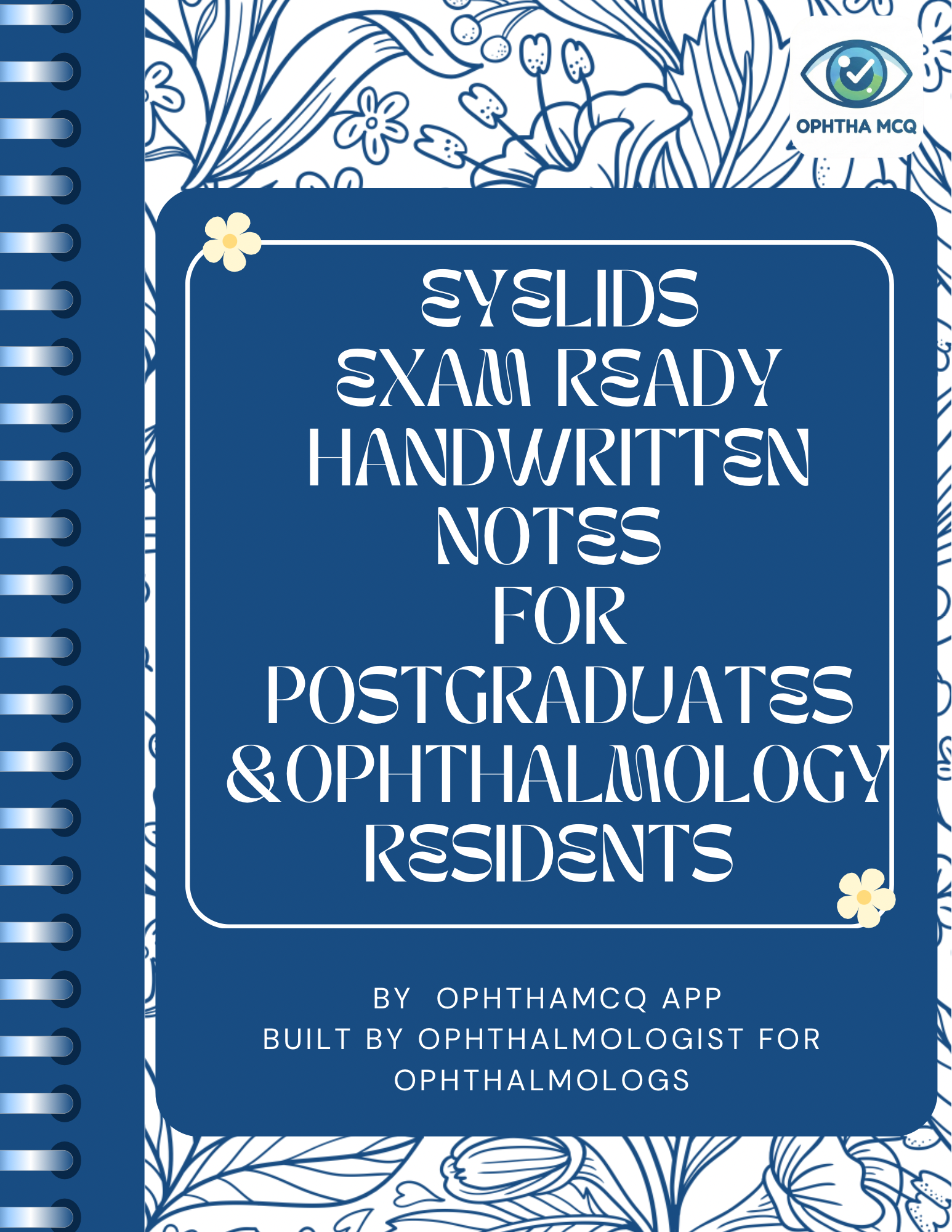
Eyelids Exam Ready Notes
Oculoplastics and eyelid disorders for your PG and fellowship exams.
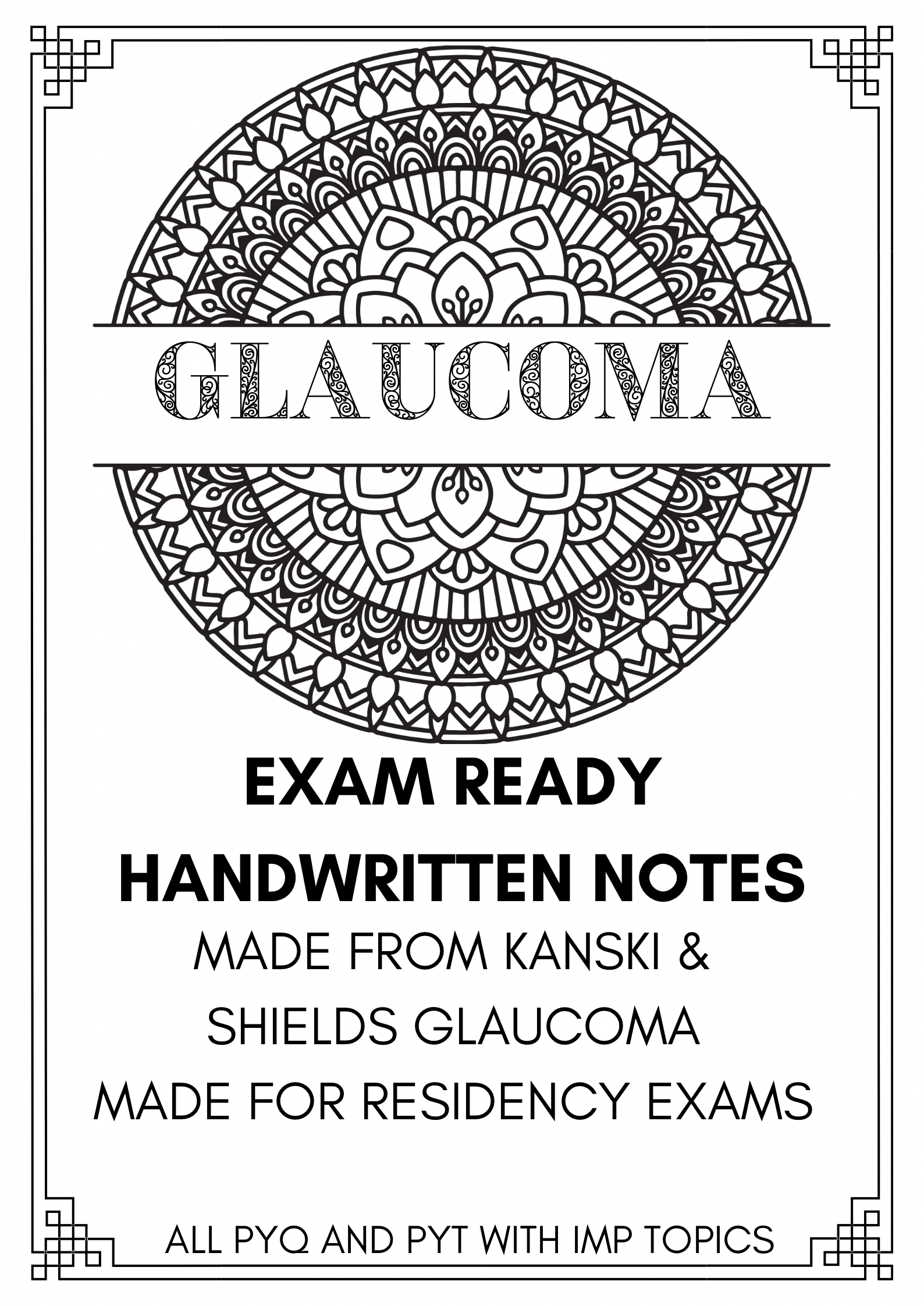
Glaucoma Exam Ready Notes
Complete glaucoma notes from pathophysiology to surgical management.
What's Included
- ✓1000+ exam-focused MCQs
- ✓Detailed explanations for every answer
- ✓Handwritten exam-ready notes
- ✓Mobile app access
- ✓Lifetime updates
Covered Topics
- ✓Eyelids
- ✓Glaucoma
- ✓Cornea
- ✓Retina
- ✓Neuro-Ophthalmology
- ✓Optics & Refraction
Instant access after purchase. Available on Android & iOS app.
FAICO MCQs
AIOS Fellowship exam MCQs mapped topic-by-topic to the FAICO syllabus.
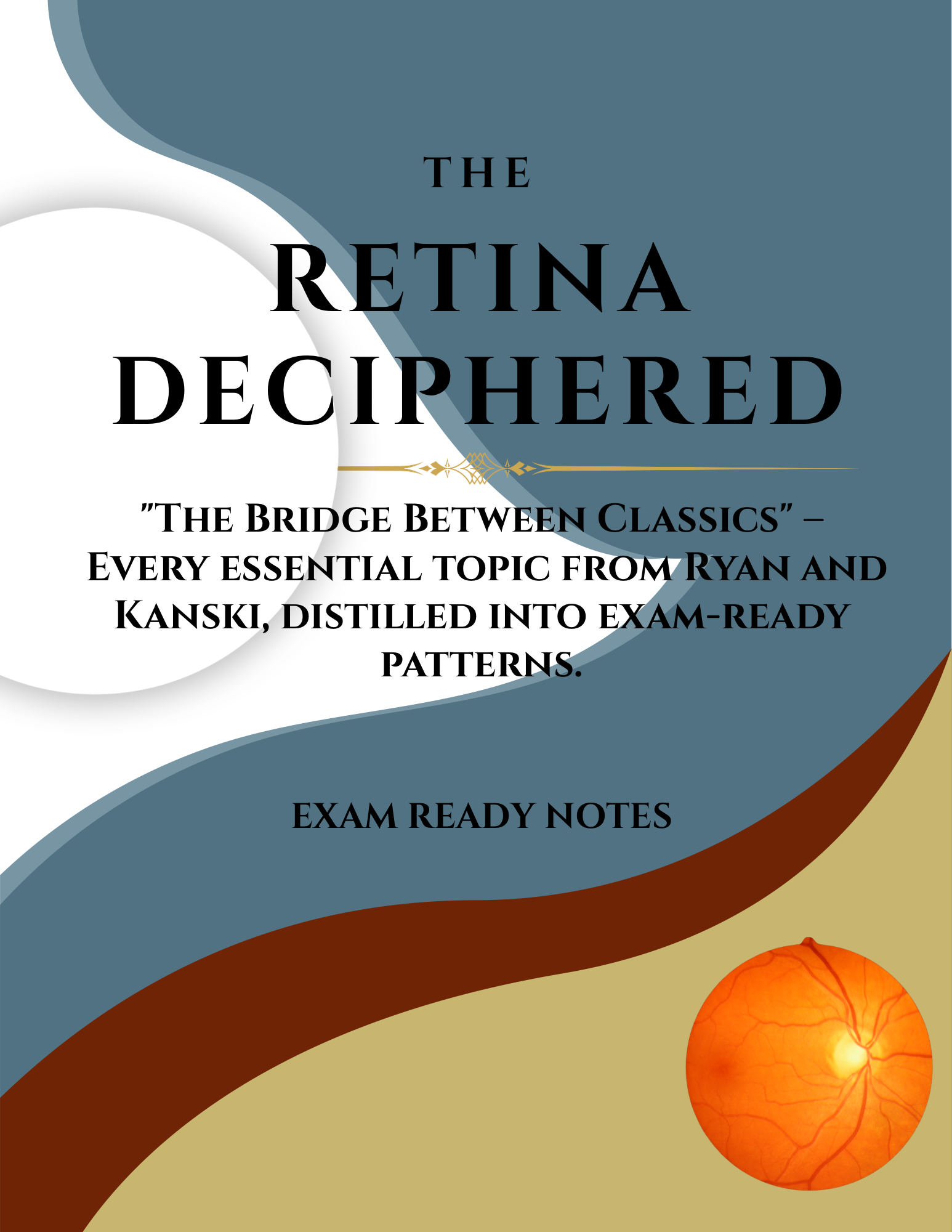
Retina Deciphered
150+ pages of handwritten exam-ready notes covering the entire retina syllabus.
Glaucoma Exam Ready Notes
Complete glaucoma notes from pathophysiology to surgical management.

What's Included
- ✓1500+ FAICO-mapped MCQs
- ✓Topic-wise detailed explanations
- ✓Handwritten subspecialty notes
- ✓Mobile app access
- ✓Regular syllabus updates
Covered Topics
- ✓Retina
- ✓Glaucoma
- ✓Cornea
- ✓Cataract
- ✓Neuro-Ophthalmology
- ✓Uveitis
Instant access after purchase. Available on Android & iOS app.
Ophthal MCQs High Yield
High-yield MCQ bank across all ophthalmology subspecialties for rapid revision.
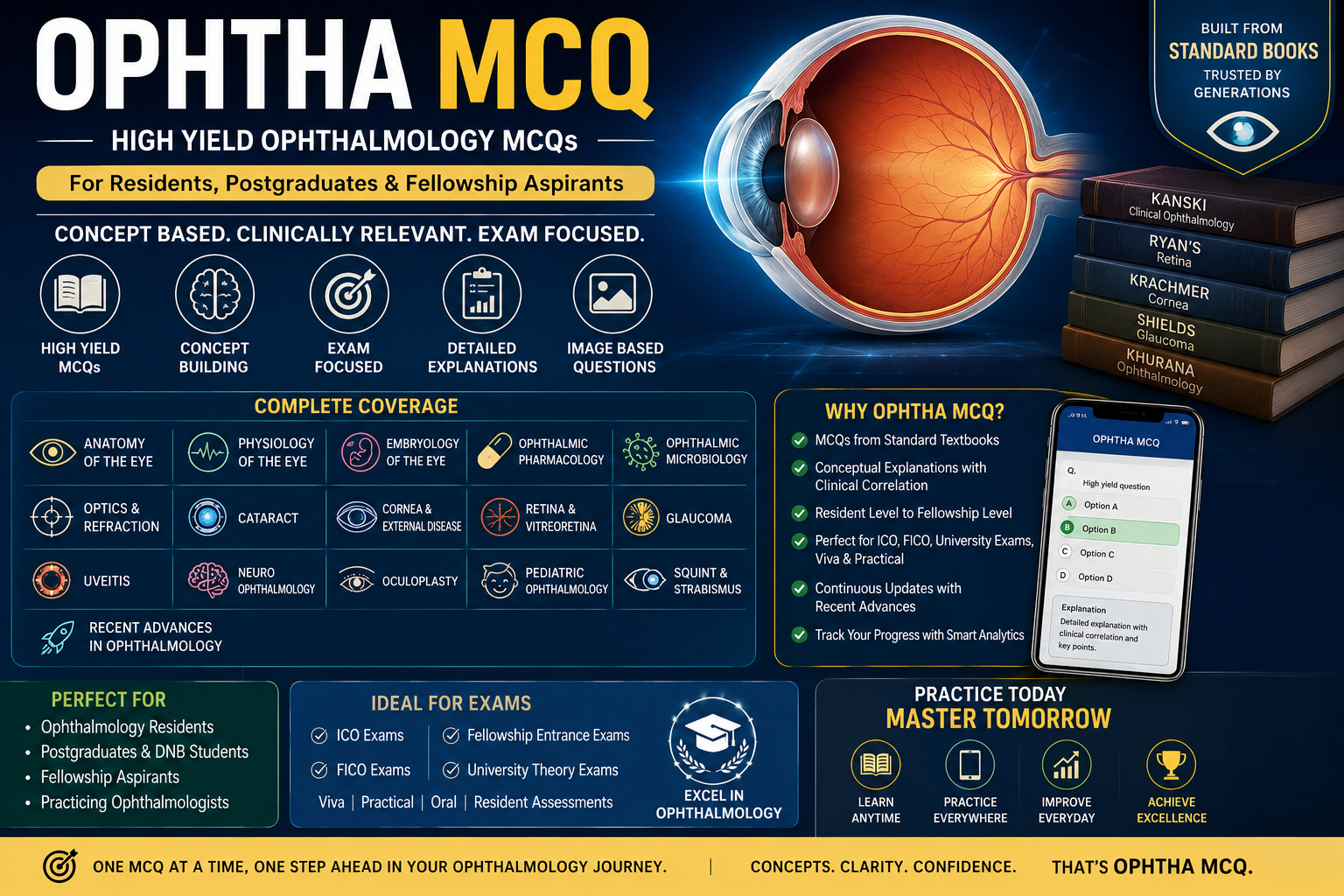
High Yield MCQs
1,000+ high-yield MCQs across all subspecialties with detailed explanations.
Eyelids Exam Ready Notes
Oculoplastics and eyelid disorders for your PG and fellowship exams.
What's Included
- ✓1000+ high-yield MCQs
- ✓Concise explanations
- ✓Quick revision notes
- ✓Mobile app access
- ✓Lifetime updates
Covered Topics
- ✓Cornea
- ✓Glaucoma
- ✓Retina
- ✓Neuro-Ophthalmology
- ✓Uveitis
- ✓Optics & Refraction
Instant access after purchase. Available on Android & iOS app.
General Ophthalmology
A mixed sampler across all ophthalmology subspecialties to test your overall readiness.
High Yield MCQs
1,000+ high-yield MCQs across all subspecialties with detailed explanations.
Retina Deciphered
150+ pages of handwritten exam-ready notes covering the entire retina syllabus.
Glaucoma Exam Ready Notes
Complete glaucoma notes from pathophysiology to surgical management.
ICO/FICO Past Papers
Last 10 years of ICO/FICO past papers with full explanations and answer keys.
What's Included
- ✓2000+ mixed ophthalmology MCQs
- ✓Cross-topic explanations
- ✓Combined notes and past papers
- ✓Mobile app access
- ✓Lifetime updates
Covered Topics
- ✓Anatomy
- ✓Optics & Refraction
- ✓Cornea
- ✓Lens & Cataract
- ✓Glaucoma
- ✓Retina
Instant access after purchase. Available on Android & iOS app.
Suggested study sequence
Six phases used by recent passers. Spread across 4–8 weeks per subspecialty.
- 1
1. Aqueous physiology and IOP control
Lock in production, drainage and IOP measurement. Foundations for every glaucoma question.
- 2
2. Angle assessment and gonioscopy
Open vs closed, Shaffer grading, plateau iris vs pupillary block.
- 3
3. Optic nerve and field assessment
Disc photography, RNFL OCT, Humphrey 24-2 interpretation patterns.
- 4
4. Medical management
Drug classes, mechanisms, side effects and combinations.
- 5
5. Laser and surgical ladders
SLT, YAG PI, trabeculectomy steps, tube shunts and MIGS.
- 6
6. Special situations
Congenital glaucoma, neovascular glaucoma, post-surgical management.
Free glaucoma sample MCQs
A taste of the exam-style stems from the full bank.
Q1.In primary open-angle glaucoma the most reliable structural test for early damage is:
Explanation: OCT of the peripapillary RNFL and macular ganglion cell complex detects structural loss earlier than visual field defects in POAG.
Q2.Classic visual field defect in glaucoma:
Explanation: Glaucomatous field loss follows the arcuate nerve fibre pattern and respects the horizontal meridian (nasal step, arcuate, Bjerrum scotoma).
Q3.First-line medical therapy for primary open-angle glaucoma:
Explanation: Prostaglandin analogues (latanoprost, travoprost, bimatoprost, tafluprost) are first-line for POAG: best IOP lowering, once-daily dosing, few systemic effects.
Glaucoma FAQ
Answers to the questions residents ask most about this topic.
What is the first-line treatment for primary open-angle glaucoma?
When should SLT be offered before drops?
How do I differentiate POAG from normal tension glaucoma?
What is the most common cause of acute angle closure?
Does OphthaMCQ cover MIGS?
Continue your prep
Jump to related exams, topics and resources.
Ready when you are
Your Ophthalmology Exam Is Coming.
Are You Ready?
The world's only ophthalmology PG exam notes and MCQ question bank — built by gold medalists who passed. Start with free sample questions today.