Neuro-Ophthalmology MCQs & Guide
350+ questions with detailed explanations. Master neuro-ophthalmology for FRCOphth, ICO, FAICO, DNB and NEET-SS.
Neuro-Ophthalmology overview
Neuro-ophthalmology sits at the interface of ophthalmology and neurology — pupils, optic nerve, visual pathways, ocular motility and higher cortical visual function. Pattern recognition is everything.
Clinical & exam importance
Neuro-ophth questions are 8–12% of most exams. Anisocoria workup, RAPD, papilloedema vs pseudopapilloedema and field defect localisation are perennial favourites.
At a glance
- MCQ bank
- 350+
- Glossary terms
- 14+
- Free sample MCQs
- 3
- Matched products
- 2
Core anatomy & physiology refresher
The foundations you need before tackling clinical and surgical MCQs.
- Visual pathway: retina → optic nerve → chiasm → optic tract → LGN → optic radiations → primary visual cortex (V1).
- Optic nerve has four parts: intraocular (1 mm), intraorbital (25 mm), intracanalicular (9 mm), intracranial (16 mm).
- Pupillary light reflex: afferent CN II → pretectal nucleus → bilateral Edinger-Westphal → CN III → ciliary ganglion → short ciliary nerves → sphincter pupillae.
- Sympathetic pathway (3 neurons): hypothalamus → ciliospinal centre of Budge → superior cervical ganglion → carotid plexus → long ciliary nerves to dilator.
- Cavernous sinus contents: CN III, IV, V1, V2, VI and internal carotid artery.
High-yield neuro-ophthalmology facts for MCQs
The facts that appear most often in real exam stems. Learn them cold.
- 1RAPD localises to optic nerve disease or extensive retinal disease — not media opacity.
- 2Optic neuritis: young women, painful loss of vision, RAPD, MRI shows demyelinating plaques.
- 3AION (arteritic vs non-arteritic): GCA must be ruled out in any patient >50 with sudden vision loss; check ESR, CRP.
- 4Papilloedema: bilateral disc swelling from raised ICP; check BP, neuroimaging, LP if no mass.
- 5Pseudotumor cerebri: young obese women, headache, papilloedema, normal imaging, raised opening pressure.
- 6Adie pupil: dilated tonic pupil, sectoral palsy, vermiform movements, constricts to dilute pilocarpine 0.125%.
- 7Argyll Robertson pupil: small irregular, light-near dissociation, classic for neurosyphilis.
- 8Horner syndrome: ptosis, miosis, anhidrosis; first-order (stroke), second-order (Pancoast), third-order (carotid dissection).
- 9CN III palsy: pupil-sparing suggests microvascular (diabetes); pupil-involving suggests aneurysm (PCom).
- 10CN IV palsy: vertical diplopia worse on contralateral gaze, head tilt to opposite side compensates.
- 11CN VI palsy: horizontal diplopia worse at distance; raised ICP is a non-localising cause.
- 12Internuclear ophthalmoplegia: MLF lesion; ipsilateral adduction failure with contralateral abducting nystagmus.
- 13Bitemporal hemianopia: chiasmal lesion, usually pituitary adenoma or craniopharyngioma.
- 14Homonymous hemianopia: retrochiasmal lesion; congruity increases the more posterior.
- 15Macular sparing in homonymous hemianopia suggests occipital lobe (dual blood supply).
Related neuro-ophthalmology glossary terms
Exam-ready definitions filtered by subspecialty.
Matched products for Neuro-Ophthalmology
Resources hand-picked for this subspecialty.
Or buy the complete bundle for your exam
These exam bundles include neuro-ophthalmology plus all the other topics you need.
General Ophthalmology
A mixed sampler across all ophthalmology subspecialties to test your overall readiness.
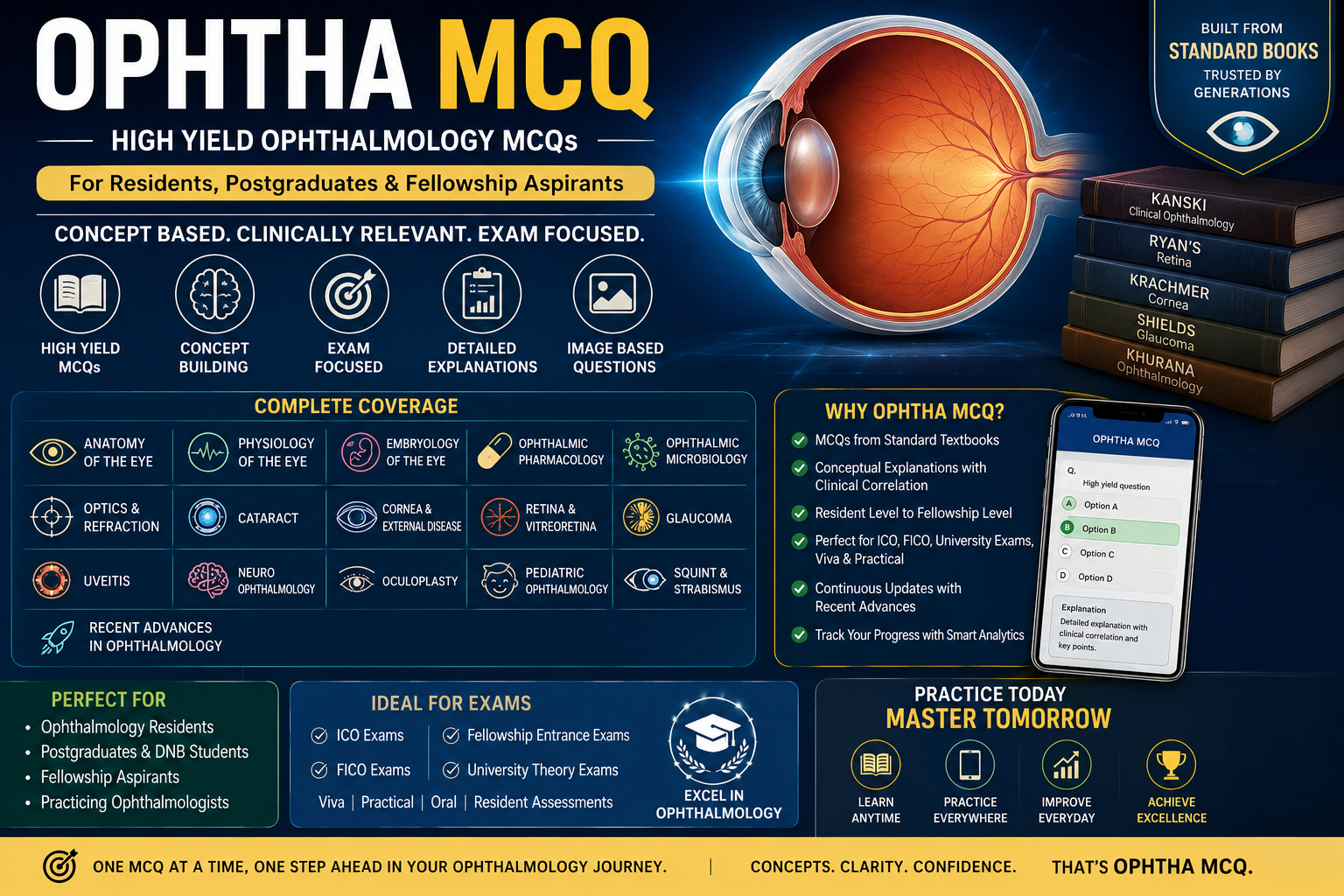
High Yield MCQs
1,000+ high-yield MCQs across all subspecialties with detailed explanations.
Retina Deciphered
150+ pages of handwritten exam-ready notes covering the entire retina syllabus.
Glaucoma Exam Ready Notes
Complete glaucoma notes from pathophysiology to surgical management.
ICO/FICO Past Papers
Last 10 years of ICO/FICO past papers with full explanations and answer keys.
What's Included
- ✓2000+ mixed ophthalmology MCQs
- ✓Cross-topic explanations
- ✓Combined notes and past papers
- ✓Mobile app access
- ✓Lifetime updates
Covered Topics
- ✓Anatomy
- ✓Optics & Refraction
- ✓Cornea
- ✓Lens & Cataract
- ✓Glaucoma
- ✓Retina
Instant access after purchase. Available on Android & iOS app.
Ophthal MCQs High Yield
High-yield MCQ bank across all ophthalmology subspecialties for rapid revision.
High Yield MCQs
1,000+ high-yield MCQs across all subspecialties with detailed explanations.
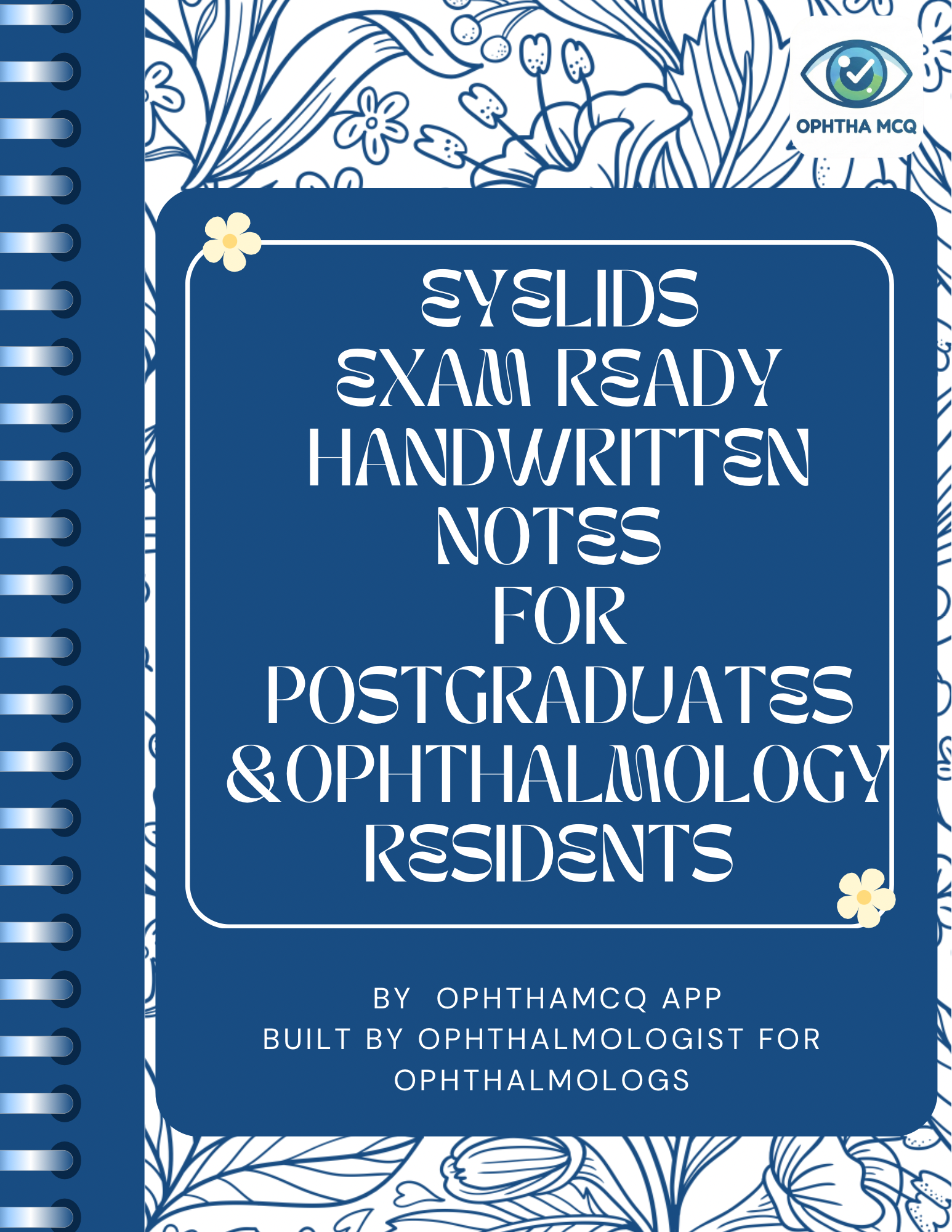
Eyelids Exam Ready Notes
Oculoplastics and eyelid disorders for your PG and fellowship exams.
What's Included
- ✓1000+ high-yield MCQs
- ✓Concise explanations
- ✓Quick revision notes
- ✓Mobile app access
- ✓Lifetime updates
Covered Topics
- ✓Cornea
- ✓Glaucoma
- ✓Retina
- ✓Neuro-Ophthalmology
- ✓Uveitis
- ✓Optics & Refraction
Instant access after purchase. Available on Android & iOS app.
Suggested study sequence
Six phases used by recent passers. Spread across 4–8 weeks per subspecialty.
- 1
1. Visual pathway anatomy
From retina to V1, with field defects mapped at each level.
- 2
2. Pupillary disorders
Anisocoria algorithm, RAPD, light-near dissociation.
- 3
3. Optic neuropathies
Optic neuritis, AION, compressive, toxic, hereditary (LHON, DOA).
- 4
4. Disc oedema differentials
Papilloedema, AION, optic neuritis, infiltration, pseudopapilloedema.
- 5
5. Eye movements
CN III, IV, VI palsies, INO, gaze palsies, nystagmus.
- 6
6. Field defects
Pattern recognition for prechiasmal, chiasmal and retrochiasmal lesions.
Free neuro-ophthalmology sample MCQs
A taste of the exam-style stems from the full bank.
Q1.A relative afferent pupillary defect (RAPD) localises pathology to:
Explanation: RAPD reflects asymmetric afferent input – usually optic nerve disease or large retinal pathology; never caused by media opacities like cataract.
Q2.A pituitary adenoma compressing the chiasm classically causes:
Explanation: Chiasmal compression interrupts decussating nasal retinal fibres producing bitemporal hemianopia.
Q3.Light-near dissociation with small irregular pupils is termed:
Explanation: Argyll Robertson pupils ("prostitute's pupils") are small, irregular pupils that accommodate but do not react to light; classically associated with neurosyphilis.
Neuro-Ophthalmology FAQ
Answers to the questions residents ask most about this topic.
How do I work up anisocoria?
When is MRI mandatory in optic neuritis?
Difference between AION and optic neuritis?
Best initial test for suspected GCA?
Recommended book for neuro-ophthalmology?
Continue your prep
Jump to related exams, topics and resources.
Ready when you are
Your Ophthalmology Exam Is Coming.
Are You Ready?
The world's only ophthalmology PG exam notes and MCQ question bank — built by gold medalists who passed. Start with free sample questions today.