Oculoplastics MCQs & Guide
250+ questions with detailed explanations. Master oculoplastics for FRCOphth, ICO, FAICO, DNB and NEET-SS.
Oculoplastics overview
Oculoplastics, lacrimal and orbital disease form the third sub-specialty by exam weight in most modern PG exams. The topic combines anatomy, surgical principles and clinical pattern recognition.
Clinical & exam importance
Oculoplastics accounts for 6–10% of most exams. Lid malpositions, lacrimal sac pathology and thyroid eye disease are reliable recurring themes. FAICO oculoplasty candidates require deep operative knowledge.
At a glance
- MCQ bank
- 250+
- Glossary terms
- 14+
- Free sample MCQs
- 3
- Matched products
- 2
Core anatomy & physiology refresher
The foundations you need before tackling clinical and surgical MCQs.
- Upper lid retractors: levator palpebrae superioris (CN III) and Müller muscle (sympathetic).
- Lower lid retractors: capsulopalpebral fascia and inferior tarsal muscle.
- Whitnall ligament acts as a fulcrum for the levator.
- Lacrimal drainage: puncta → canaliculi → common canaliculus → lacrimal sac → nasolacrimal duct → inferior meatus (valve of Hasner).
- Orbital walls: medial (lamina papyracea) thinnest; floor (maxilla) common in blowout fracture.
High-yield oculoplastics facts for MCQs
The facts that appear most often in real exam stems. Learn them cold.
- 1Ptosis classification: aponeurotic, myogenic, neurogenic, mechanical, traumatic.
- 2Levator function grading: poor (<4 mm), fair (5–7 mm), good (8–12 mm), excellent (>12 mm).
- 3Surgical choice: good function — levator advancement; poor function — frontalis sling.
- 4Entropion: most often involutional (lower lid laxity); cicatricial in trachoma and SJS.
- 5Ectropion: involutional, cicatricial, paralytic (CN VII palsy), mechanical.
- 6Lagophthalmos management: lubricants, taping, gold weight implant, lateral tarsorrhaphy.
- 7Chalazion: chronic granulomatous inflammation of meibomian gland; treat with warm compresses, lid hygiene, I&C if persistent.
- 8Hordeolum: acute staphylococcal infection of meibomian (internal) or Zeiss (external) gland.
- 9Basal cell carcinoma: most common eyelid malignancy; pearly nodule with telangiectasia; medial canthus most common.
- 10Sebaceous gland carcinoma: masquerade as chronic chalazion; pagetoid spread, biopsy mandatory.
- 11Congenital nasolacrimal duct obstruction: epiphora from birth, resolves spontaneously by 12 months in most; probe at 12 months if persistent.
- 12Acute dacryocystitis: painful swelling over lacrimal sac; treat with systemic antibiotics, then DCR.
- 13External DCR vs endonasal DCR: external has slightly higher success but visible scar.
- 14Thyroid eye disease: upper lid retraction, lid lag (von Graefe), proptosis, EOM restriction (IR, MR most affected); IOSS or Hertel measurement.
- 15Blowout fracture: inferior rectus entrapment causes diplopia; oculocardiac reflex needs urgent surgery in white-eyed blowout.
Related oculoplastics glossary terms
Exam-ready definitions filtered by subspecialty.
Matched products for Oculoplastics
Resources hand-picked for this subspecialty.
Or buy the complete bundle for your exam
These exam bundles include oculoplastics plus all the other topics you need.
PD-CET Ophthal
Post Diploma Centralized Entrance Test preparation with high-yield MCQs and notes.

Eyelids Exam Ready Notes
Oculoplastics and eyelid disorders for your PG and fellowship exams.
Glaucoma Exam Ready Notes
Complete glaucoma notes from pathophysiology to surgical management.
What's Included
- ✓1000+ exam-focused MCQs
- ✓Detailed explanations for every answer
- ✓Handwritten exam-ready notes
- ✓Mobile app access
- ✓Lifetime updates
Covered Topics
- ✓Eyelids
- ✓Glaucoma
- ✓Cornea
- ✓Retina
- ✓Neuro-Ophthalmology
- ✓Optics & Refraction
Instant access after purchase. Available on Android & iOS app.
Ophthal MCQs High Yield
High-yield MCQ bank across all ophthalmology subspecialties for rapid revision.
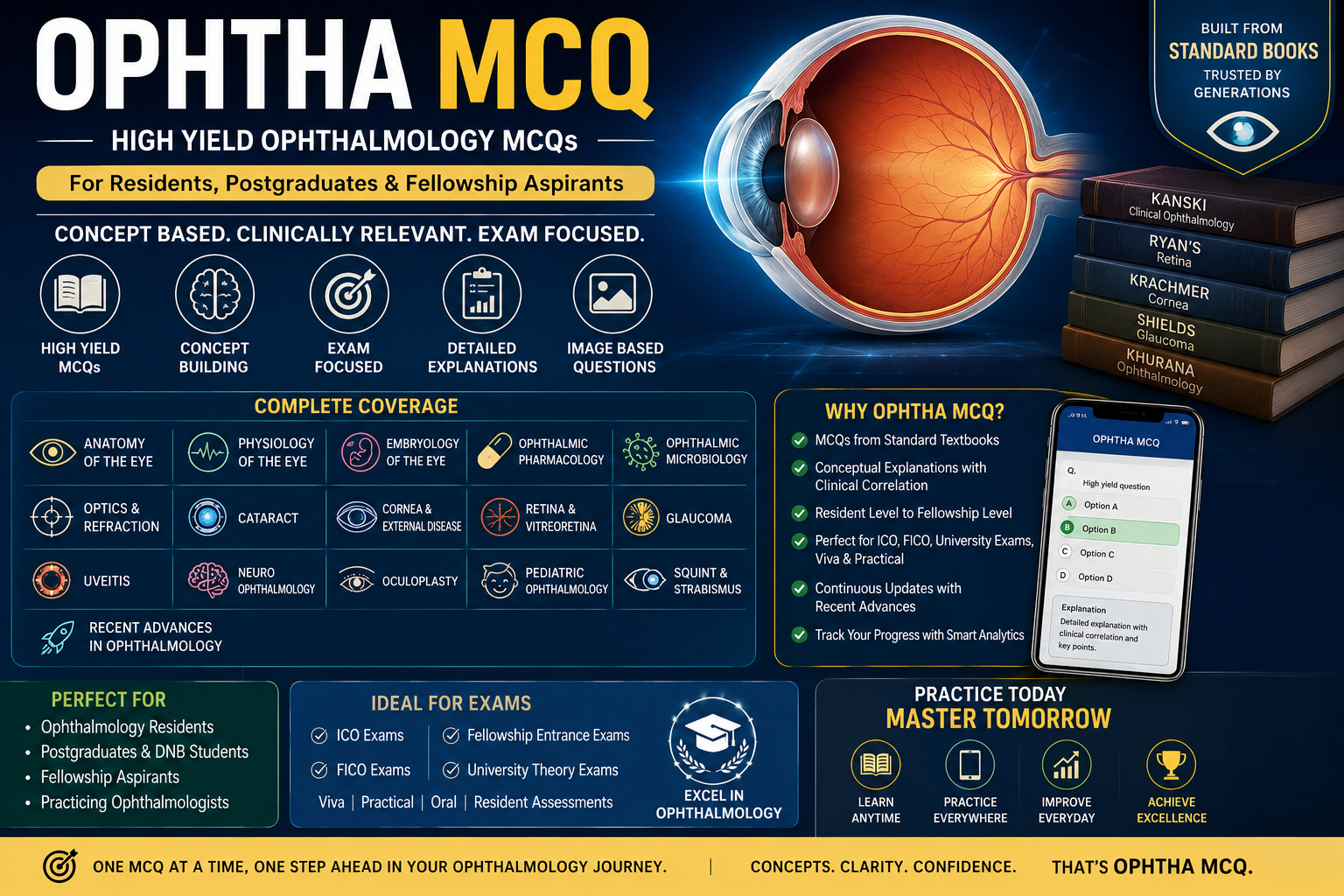
High Yield MCQs
1,000+ high-yield MCQs across all subspecialties with detailed explanations.
Eyelids Exam Ready Notes
Oculoplastics and eyelid disorders for your PG and fellowship exams.
What's Included
- ✓1000+ high-yield MCQs
- ✓Concise explanations
- ✓Quick revision notes
- ✓Mobile app access
- ✓Lifetime updates
Covered Topics
- ✓Cornea
- ✓Glaucoma
- ✓Retina
- ✓Neuro-Ophthalmology
- ✓Uveitis
- ✓Optics & Refraction
Instant access after purchase. Available on Android & iOS app.
General Ophthalmology
A mixed sampler across all ophthalmology subspecialties to test your overall readiness.
High Yield MCQs
1,000+ high-yield MCQs across all subspecialties with detailed explanations.
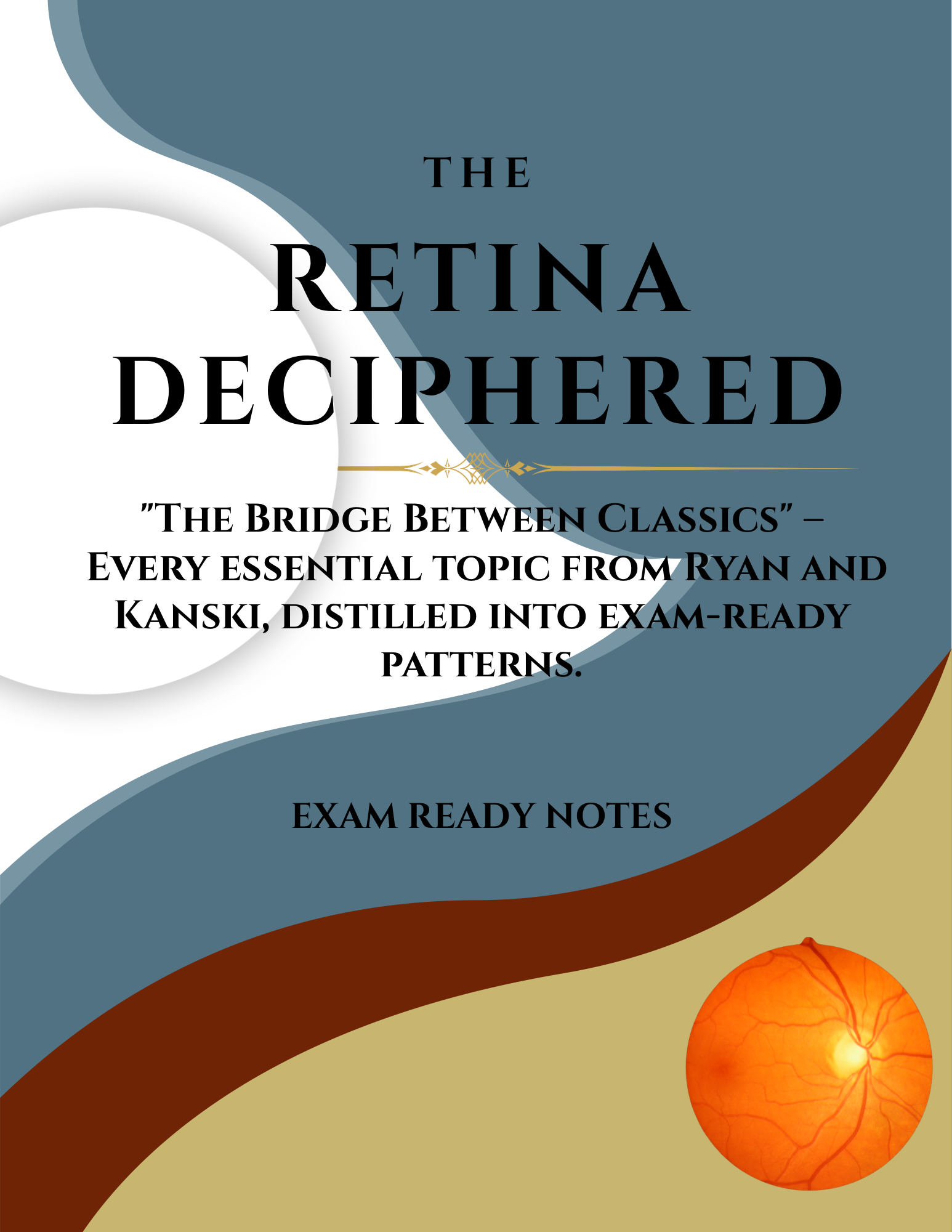
Retina Deciphered
150+ pages of handwritten exam-ready notes covering the entire retina syllabus.
Glaucoma Exam Ready Notes
Complete glaucoma notes from pathophysiology to surgical management.
ICO/FICO Past Papers
Last 10 years of ICO/FICO past papers with full explanations and answer keys.
What's Included
- ✓2000+ mixed ophthalmology MCQs
- ✓Cross-topic explanations
- ✓Combined notes and past papers
- ✓Mobile app access
- ✓Lifetime updates
Covered Topics
- ✓Anatomy
- ✓Optics & Refraction
- ✓Cornea
- ✓Lens & Cataract
- ✓Glaucoma
- ✓Retina
Instant access after purchase. Available on Android & iOS app.
Suggested study sequence
Six phases used by recent passers. Spread across 4–8 weeks per subspecialty.
- 1
1. Lid anatomy and physiology
Layers, retractors, blood supply, innervation.
- 2
2. Lid malpositions
Ptosis, entropion, ectropion, lagophthalmos with surgical algorithms.
- 3
3. Lid lesions and tumours
Benign vs malignant pattern recognition, biopsy and Mohs.
- 4
4. Lacrimal disease
Drainage anatomy, dacryocystitis, DCR techniques.
- 5
5. Orbital disease
Thyroid eye disease, idiopathic orbital inflammation, cellulitis, tumours.
- 6
6. Trauma and reconstruction
Lid laceration, blowout fracture, anophthalmic socket management.
Free oculoplastics sample MCQs
A taste of the exam-style stems from the full bank.
Q1.Most common cause of unilateral proptosis in adults:
Explanation: Thyroid eye disease (Graves') is the most common cause of unilateral and bilateral proptosis in adults.
Q2.In thyroid eye disease the most commonly enlarged extraocular muscle is:
Explanation: TED most often enlarges inferior and medial recti (mnemonic "I'M SLOw"). The tendinous insertions are characteristically spared.
Q3.Most common cause of acquired blepharoptosis in adults:
Explanation: Involutional aponeurotic ptosis (disinsertion or thinning of the levator aponeurosis) is the most common cause of acquired adult ptosis.
Oculoplastics FAQ
Answers to the questions residents ask most about this topic.
When to operate on congenital ptosis?
Best procedure for severe ptosis with poor levator function?
When is DCR indicated?
How to manage active thyroid eye disease?
Recommended oculoplastics book?
Continue your prep
Jump to related exams, topics and resources.
Ready when you are
Your Ophthalmology Exam Is Coming.
Are You Ready?
The world's only ophthalmology PG exam notes and MCQ question bank — built by gold medalists who passed. Start with free sample questions today.