Pediatric Ophthalmology MCQs & Guide
300+ questions with detailed explanations. Master pediatric ophthalmology for FRCOphth, ICO, FAICO, DNB and NEET-SS.
Pediatric Ophthalmology overview
Paediatric ophthalmology and strabismus is a high-stakes subspecialty — early diagnosis prevents irreversible amblyopia and developmental delay. Questions span amblyopia, strabismus, ROP, congenital cataract and glaucoma.
Clinical & exam importance
Paeds accounts for 8–10% of most exams. NEET-SS paediatric/strabismus fellowship is one of the most competitive sub-specialty seats. FAICO paeds depth is significant.
At a glance
- MCQ bank
- 300+
- Glossary terms
- 14+
- Free sample MCQs
- 3
- Matched products
- 2
Core anatomy & physiology refresher
The foundations you need before tackling clinical and surgical MCQs.
- Visual development: VEP-measurable from birth, adult acuity by 6–8 years.
- Critical period for amblyopia: birth to 7–8 years; plastic to 12 years for some treatments.
- Axial length at birth ~17 mm, reaches adult length (~23 mm) by age 13.
- Corneal diameter at birth 10 mm; adult 11.7 mm.
- IOL power changes with axial growth — adjustments required for pediatric IOLs.
High-yield pediatric ophthalmology facts for MCQs
The facts that appear most often in real exam stems. Learn them cold.
- 1Amblyopia types: strabismic, anisometropic (≥1.5 D), deprivational (worst), bilateral ametropic.
- 2Treatment of amblyopia: refractive correction first, then occlusion or atropine penalisation.
- 3Esotropia: infantile (large angle, onset <6 months), accommodative (refractive), partially accommodative.
- 4Exotropia: intermittent (most common), constant, sensory.
- 5Inferior oblique overaction: V-pattern strabismus; treat with IO weakening procedures.
- 6Brown syndrome: limited elevation in adduction; congenital (tight superior oblique tendon) or acquired (trauma, inflammation).
- 7Duane retraction syndrome: type I (limited abduction), type II (limited adduction), type III (both); CN VI nucleus abnormality with aberrant CN III innervation.
- 8Leukocoria differential: retinoblastoma, congenital cataract, Coats disease, PHPV, ROP, toxocariasis.
- 9Retinoblastoma: most common intraocular malignancy of childhood; RB1 gene on 13q14.
- 10Group A–E retinoblastoma (International Classification); E carries highest enucleation rate.
- 11ROP screening: birth weight ≤1500 g or gestational age ≤30 weeks; first screen at 31 weeks PMA or 4 weeks chronological.
- 12ROP zones (I innermost, III outermost), stages (1–5), plus disease and aggressive posterior ROP.
- 13Treatment threshold: Type 1 ROP (any zone I stage 3, zone I plus, zone II stage 2 or 3 plus).
- 14Congenital glaucoma triad: epiphora, photophobia, blepharospasm.
- 15Goniotomy and trabeculotomy are first-line surgeries for primary congenital glaucoma.
Related pediatric ophthalmology glossary terms
Exam-ready definitions filtered by subspecialty.
Matched products for Pediatric Ophthalmology
Resources hand-picked for this subspecialty.
Or buy the complete bundle for your exam
These exam bundles include pediatric ophthalmology plus all the other topics you need.
FAICO MCQs
AIOS Fellowship exam MCQs mapped topic-by-topic to the FAICO syllabus.
Retina Deciphered
150+ pages of handwritten exam-ready notes covering the entire retina syllabus.
Glaucoma Exam Ready Notes
Complete glaucoma notes from pathophysiology to surgical management.

What's Included
- ✓1500+ FAICO-mapped MCQs
- ✓Topic-wise detailed explanations
- ✓Handwritten subspecialty notes
- ✓Mobile app access
- ✓Regular syllabus updates
Covered Topics
- ✓Retina
- ✓Glaucoma
- ✓Cornea
- ✓Cataract
- ✓Neuro-Ophthalmology
- ✓Uveitis
Instant access after purchase. Available on Android & iOS app.
Ophthal MCQs High Yield
High-yield MCQ bank across all ophthalmology subspecialties for rapid revision.
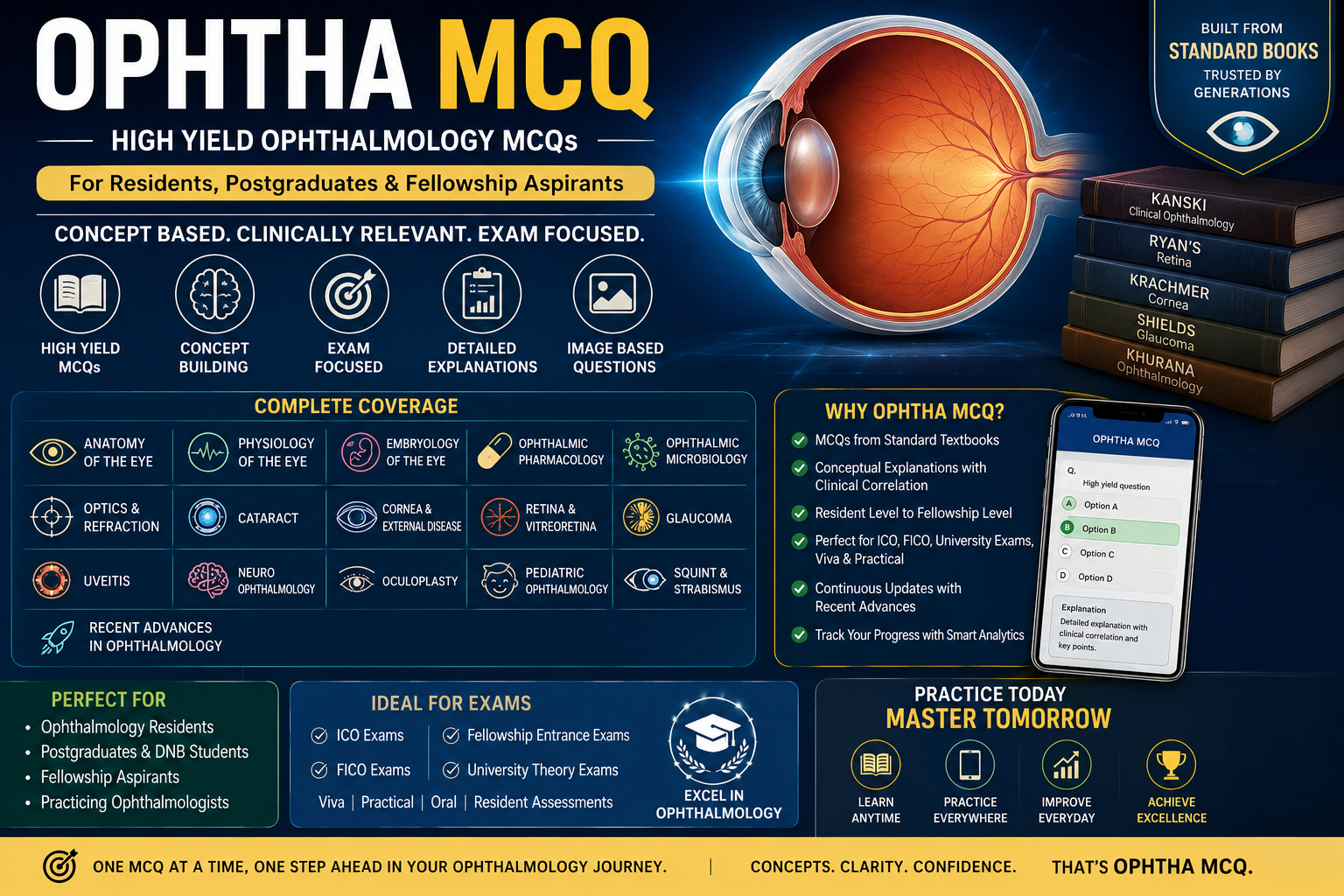
High Yield MCQs
1,000+ high-yield MCQs across all subspecialties with detailed explanations.
Eyelids Exam Ready Notes
Oculoplastics and eyelid disorders for your PG and fellowship exams.
What's Included
- ✓1000+ high-yield MCQs
- ✓Concise explanations
- ✓Quick revision notes
- ✓Mobile app access
- ✓Lifetime updates
Covered Topics
- ✓Cornea
- ✓Glaucoma
- ✓Retina
- ✓Neuro-Ophthalmology
- ✓Uveitis
- ✓Optics & Refraction
Instant access after purchase. Available on Android & iOS app.
Suggested study sequence
Six phases used by recent passers. Spread across 4–8 weeks per subspecialty.
- 1
1. Visual development
Acuity milestones, sensitive periods, refractive trajectory.
- 2
2. Amblyopia
Classification, screening, treatment ladders.
- 3
3. Strabismus
ET, XT, A and V patterns, special syndromes, surgical approaches.
- 4
4. ROP
Screening criteria, classification, treatment thresholds, anti-VEGF role.
- 5
5. Anterior segment disorders
Congenital cataract, glaucoma, anterior segment dysgenesis.
- 6
6. Posterior segment and tumours
Retinoblastoma, Coats, FEVR, juvenile retinoschisis.
Free pediatric ophthalmology sample MCQs
A taste of the exam-style stems from the full bank.
Q1.A child with leukocoria, strabismus, and a heritable family history – most concerning diagnosis:
Explanation: Leukocoria in a child must rule out retinoblastoma – the most common intra-ocular malignancy in childhood, often heritable (RB1 mutation).
Q2.Critical period for visual development is approximately:
Explanation: Visual development is most sensitive in the first 2 years but plasticity extends to 7–8 years; amblyopia treatment is most effective during this period.
Q3.Most common type of childhood strabismus:
Explanation: Accommodative (refractive) esotropia is the most common childhood esotropia, typically presenting at 2-3 years in a hyperope; treated with full hypermetropic correction.
Pediatric Ophthalmology FAQ
Answers to the questions residents ask most about this topic.
When should amblyopia treatment start?
What is the gold standard treatment for primary congenital glaucoma?
ROP screening criteria?
When to consider surgery for intermittent exotropia?
Recommended book for paediatric ophthalmology?
Continue your prep
Jump to related exams, topics and resources.
Ready when you are
Your Ophthalmology Exam Is Coming.
Are You Ready?
The world's only ophthalmology PG exam notes and MCQ question bank — built by gold medalists who passed. Start with free sample questions today.