How Bulk Licensing Pricing for Eye Hospitals Works for Resident Training

A residency program buying bulk licensing pricing for eye hospitals pays one institutional fee for a fixed number of resident seats, instead of each trainee purchasing MCQ banks and notes separately. The per-resident cost usually falls as cohort size grows, but the real savings depend on rollout logistics, not just the quote. This guide walks program administrators through the math and the process.
Key Takeaways
- One agreement, many seats: Bulk licensing pools access for an entire resident cohort under a single institutional purchase, replacing 15-30 separate individual transactions.
- Cost-per-resident falls with scale: Larger teaching hospitals with bigger cohorts typically unlock lower per-seat pricing than small programs, but administrators should always request current institutional rates rather than assume a fixed number.
- Rollout needs a plan, not just a purchase order: A named coordinator, a complete resident roster, and a device/access policy determine whether the license actually gets used.
- Theory and practical content should both be included: A bulk deal that only covers MCQ theory banks and skips OSCE/viva prep leaves residents under-prepared for practical exams.
- Timing matters as much as price: Licenses activated right before DNB theory or OSCE season see far higher usage than ones bought mid-cycle with no exam deadline in sight.
Bulk Licensing at a Glance
| Factor | Individual Purchases | Bulk/Institutional License |
|---|---|---|
| Who buys | Each resident, separately | Program/hospital administration, once |
| Admin overhead | High — multiple receipts, no oversight | Low — one invoice, one point of contact |
| Cost predictability | Varies resident to resident | Fixed per-seat cost agreed upfront |
| Content typically included | Whatever each resident chooses to buy | MCQs, handwritten notes, OSCE/viva bundle, past papers |
| Usage visibility for faculty | None | Program-level visibility on adoption |
| Best suited for | Solo trainees or very small programs | DNB/MS/DO programs, fellowship cohorts, teaching hospitals |
| Renewal cycle | Ad hoc, resident by resident | Aligned to academic year or exam cycle |
Eye hospitals running DNB, MS, or DO programs are increasingly asking the same question: does it make more sense to let each resident buy their own exam prep tools, or to license access for the whole cohort at once? The answer depends on how the numbers actually work out, and on whether the rollout is planned properly. Below, we break down both.
1. What Bulk Licensing Actually Means for an Eye Hospital
An institutional or bulk license is a single agreement covering a defined group of residents, rather than a stack of individual consumer purchases. Instead of each trainee separately buying an MCQ bank or a set of handwritten notes, the hospital or residency program signs one arrangement that provisions access for the whole batch.
This model applies naturally to DNB, MS, and DO ophthalmology programs, where a fixed number of residents rotate through the same syllabus every year. It also fits fellowship cohorts preparing for FAICO or similar subspecialty exams, where a department may want every fellow working from the same syllabus-mapped material.
Contrast this with the default today in most programs: residents each find their own resources, often at different times, with no coordination. One resident buys a question bank in year one; another waits until three months before the exam. Program directors get no visibility into who's actually preparing, and the hospital pays nothing toward a resource that directly affects its practical exam pass rates. Our earlier piece on how to use an MCQ bank for ophthalmology PG exams covers the individual-resident side of this; bulk licensing is the institutional mirror of that same workflow.
2. Why Eye Hospitals Consider Bulk Licensing Over Individual Purchases
Three pressures usually push a program toward bulk licensing conversations.
First, there's administrative friction. Tracking reimbursements or informal collections for 15 to 30 residents, each buying different products at different times, is a real time cost for coordinators and program directors. A single institutional invoice replaces that entirely.
Second, institutional budgets don't run per-resident. Most eye hospitals allocate an annual education or training budget rather than approving individual resident purchases as they come up. Bulk licensing fits that annual planning cycle far better than a patchwork of one-off transactions spread across the year.
Third, there's an equity issue that program directors care about. Senior residents who've already invested in their own materials are set. First-years who haven't started yet are not. A hospital-wide license means every resident, regardless of when they joined or what they can personally afford, starts from the same baseline on day one.
Program directors increasingly want to know not just whether residents bought a resource, but whether they're using it consistently before the exam. Bulk licensing with usage visibility solves a problem individual purchases never could.
3. How Cost-Per-Resident Is Calculated in Bulk Pricing
The core math behind bulk licensing is simple on paper: take the total license fee for the cohort and divide by the number of seats. A program with 20 residents on a bulk quote divides the total by 20 to get its true cost-per-resident. That number is what should be compared against what a resident would otherwise spend buying products individually.
What complicates this in practice is tiering. Larger teaching hospitals with bigger cohorts generally see the per-seat number drop as volume increases, while a small program with five or six residents sits at a different point on the pricing curve. There's no universal public rate card that applies to every hospital, because cohort size, the exams residents are preparing for (DNB theory only, or DNB plus OSCE/viva, or FAICO), and the mix of products needed (MCQs, handwritten notes, past papers, or all three) all shift the total.
OphthaMCQ's individual products are priced one-time, in the roughly ₹249-1,799 range depending on the subspecialty and product type, with lifetime access rather than a recurring subscription. That's the baseline administrators should use when running their own comparison: multiply what a single resident would spend buying the MCQ bank, the handwritten notes, and the OSCE bundle separately, then compare that total against the quoted bulk rate for the same cohort size. Because bulk terms are negotiated per institution and can change, the most reliable next step is to contact the OphthaMCQ team directly with your resident count and ask about current institutional rates, rather than assume a fixed number.

A useful sanity check for administrators: if the quoted bulk rate per resident comes out higher than what residents would pay buying products individually at list price, the license isn't doing its job. The value of bulk pricing should show up clearly in the per-seat number, not just in the convenience of a single invoice.
Bulk Licensing vs Individual Purchases: A Side-by-Side Comparison
The table below breaks the decision down across the dimensions that matter most to a program administrator evaluating a quote, rather than just the sticker price.
| Dimension | Individual Purchase (per resident) | Small Bulk License (roughly 10-20 residents) | Large Bulk License (20+ residents) |
|---|---|---|---|
| Purchase process | Each resident buys separately, on their own timeline | Single order for the batch, coordinated by program office | Single institutional contract, often renewed with the academic year |
| Cost predictability | Unpredictable, depends on individual choices | Fixed and known upfront for the whole batch | Fixed, typically with the lowest per-seat rate available |
| Content coverage risk | High, some residents may skip OSCE/practical content to save money | Low if the bundle is specified upfront (MCQs + notes + OSCE) | Low, with room to standardize content across subspecialties |
| Admin overhead | High, multiple transactions, no oversight | Moderate, one point of contact manages the roster | Low relative to cohort size, provisioning is systemized |
| Renewal alignment | Ad hoc | Can align to exam cycle (e.g., before DNB theory) | Aligns to academic year, easier long-term budgeting |
| Best fit | Solo trainees, very small departments | Single-batch DNB/MS/DO programs | Large teaching hospitals with multiple concurrent cohorts |
4. What Should Be Included in a Bulk License for Residents
A bulk license is only as useful as the content it unlocks. For ophthalmology residents, the bundle should cover both the theory exam and the practical/viva component, since these are tested separately and require different preparation.
- MCQ bank access mapped to the specific exam the cohort is preparing for, DNB, MS, DO, FAICO, or ICO/FICO, rather than a generic medical question bank.
- Handwritten exam-ready notes across ophthalmology subspecialties (cornea, glaucoma, retina, cataract/IOL, neuro-ophthalmology, oculoplasty, paediatric ophthalmology, optics and refraction, pharmacology), distilled from standard texts like Kanski, Ryan Retina, Elkington, and BCSC.
- An OSCE, Practical, and Viva Voce bundle covering instruments, case presentation, and investigations, the part of the exam individual MCQ purchases often skip entirely. Our guide on prepping DNB theory and practicals together explains why splitting these two into separate study tracks hurts residents at exam time.
- Past papers with full explanations where relevant to the exam, since pattern recognition across ten years of previous papers is one of the highest-yield activities before a board exam.
- Mobile app access with offline mode, so residents on ward duty or night call can keep revising without depending on hospital Wi-Fi.
If a bulk quote only includes the MCQ theory bank and leaves out OSCE/practical content, ask directly whether that bundle can be added. Many programs sign a license assuming it's comprehensive, only to discover residents are still buying practical exam prep separately months later.
5. How to Evaluate a Bulk Licensing Quote as an Administrator
Before signing off on any bulk arrangement, an administrator should be able to answer these questions clearly.
- What is the actual per-seat cost at our current cohort size? Ask for the total fee and divide it yourself, rather than accepting a headline "bulk discount" claim at face value.
- What happens when residents graduate mid-cycle? DNB and MS programs have staggered entry and exit points. Find out whether seats can be reassigned to incoming residents or whether the license is fixed per named individual.
- How often is content refreshed? Ophthalmology guidelines and exam patterns shift. A license tied to a stale question bank loses value fast.
- Does offline access actually work on the wards? Residents study during night duty and between cases, often without reliable internet. Confirm the app's offline mode before committing a full cohort to it.
- What support channel exists if residents have access issues? A single coordinator managing 25 logins needs a direct line to support, not a generic ticketing queue.

It's also worth pulling in faculty who directly assess OSCE and viva performance. They see which residents struggle with instrument identification or case presentation, and their input on what content the bulk bundle should prioritize is more useful than a purely budget-driven decision made in isolation.
6. Planning the Rollout: From Purchase Order to Resident Login
A signed bulk license doesn't automatically translate into residents actually using it. Rollout needs the same discipline as any other institutional process.
- Appoint a single point of contact. Usually the program coordinator or a senior faculty member, responsible for the roster, account provisioning, and follow-up.
- Compile the complete resident roster with names, year of training, and contact details (email or phone) before reaching out, so account setup isn't delayed by missing information.
- Decide the device policy. Will residents use personal phones, or will the hospital provide shared tablets in the resident room? Confirm the app supports offline mode reliably on whichever devices are chosen, since ward duty often means patchy connectivity.
- Time the onboarding window to a specific exam cycle, ideally a few weeks before DNB theory prep intensifies, or ahead of OSCE season, rather than mid-year with no immediate deadline driving usage.
- Set a check-in point at four to six weeks to review actual usage data before any renewal conversation. If uptake is low, that's the moment to find out why, not after the license has expired.
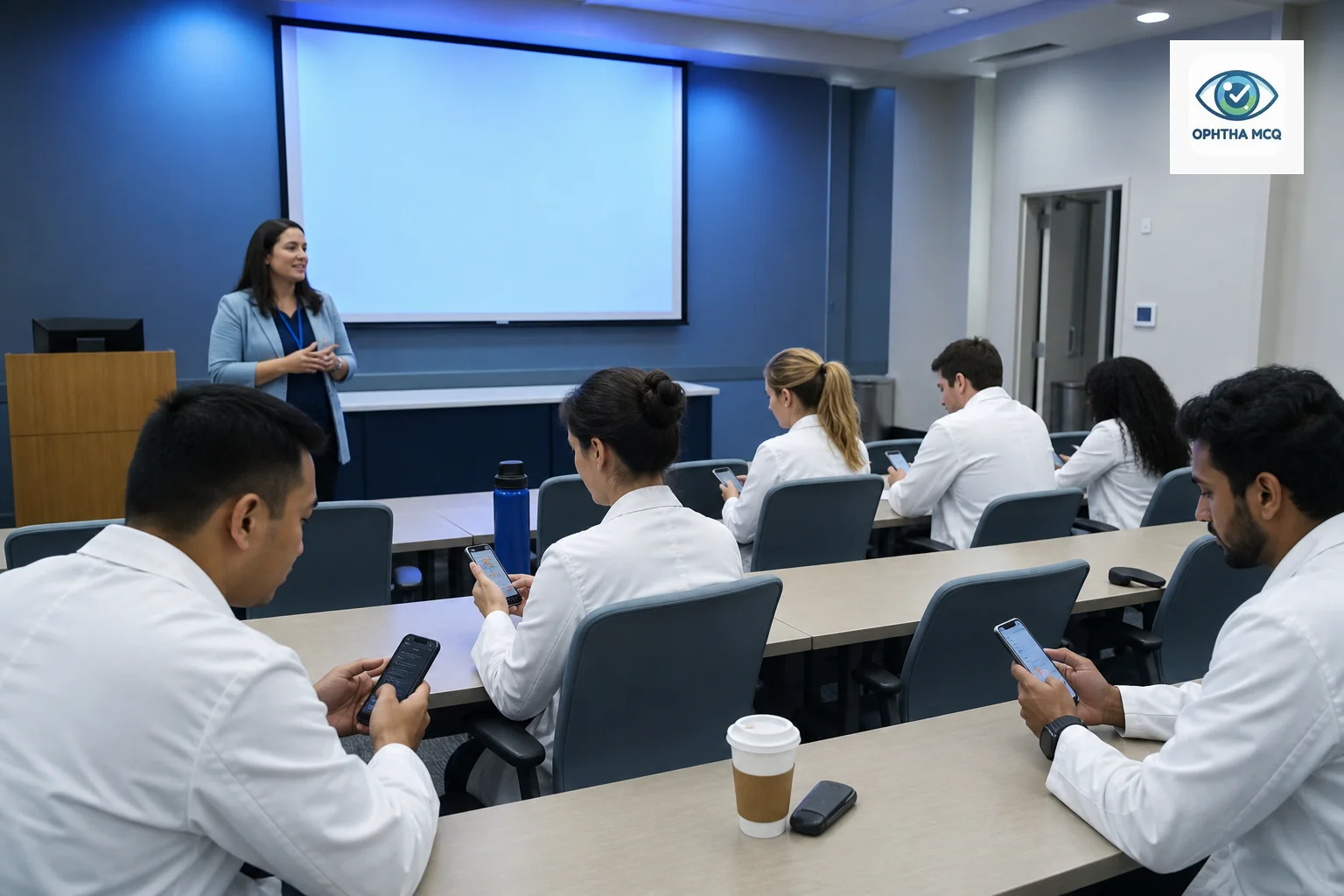
Programs that run a short, mandatory onboarding session, even 20 minutes, showing residents how to download the app, log in, and set up offline access, see far higher early adoption than programs that simply email login credentials and hope residents figure it out on their own.
7. Common Rollout Mistakes Eye Hospitals Should Avoid
A few patterns show up repeatedly when bulk licenses underperform.
The most common mistake is buying access without a firm resident count. Programs sometimes license for a round number instead of the actual cohort size, leaving unused seats that were paid for. Get an exact headcount before finalizing any quote.
Skipping onboarding is another frequent issue. Without a structured session, uptake in the first month tends to stay low, and residents fall back on the same textbook-first habits described in our piece on using an MCQ bank effectively for PG exams. Some hospitals also license only theory MCQs while ignoring OSCE and viva-specific content, then wonder why practical exam scores don't move. And finally, timing the license launch outside the exam calendar, say, right after DNB results instead of before the next theory cycle, wastes months of potential study time before residents feel any urgency to log in.
Frequently Asked Questions
Does bulk licensing work for mixed cohorts, such as DNB and MS residents in the same hospital?
Yes. Bulk licenses can cover mixed cohorts as long as the content bundle includes material relevant to each track. Since DNB and MS syllabi overlap substantially in ophthalmology, most hospitals find a single bundle works for both, with the OSCE/practical component being especially useful across tracks.
Can residents keep access after they finish the residency program?
This depends on how the license is structured, whether seats are tied to named individuals with lifetime access or reassigned annually as residents rotate through. Ask this explicitly before signing, since it affects whether outgoing residents lose access right when they need it most for final exams.
Is bulk licensing available for international programs outside India?
Yes. OphthaMCQ's content maps to ICO/FICO and FRCOphth syllabi in addition to DNB/MS/DO and PDCET, which makes bulk arrangements relevant for residency programs and eye hospitals across the UK, Gulf region, and other countries training toward these international exams. Programs preparing trainees for FRCOphth in particular may also want to review our breakdown of UK ophthalmology trainee exam prep budgets for context on how individual and institutional costs compare there.
How is bulk pricing different from a subscription model like some international question banks use?
Bulk licensing here is structured around one-time institutional pricing for lifetime access, rather than a recurring subscription that residents (or the hospital) pay repeatedly over months. This matters for budget planning, since a one-time institutional fee is easier to approve through an annual education budget than an open-ended recurring cost.
Cost-per-resident only tells half the story. The other half is whether the license actually gets used before the exam that matters. If you're weighing bulk licensing pricing for eye hospitals against letting residents buy individually, start by comparing your cohort's actual numbers against OphthaMCQ's Notes & MCQs catalog, or let residents try the 200 free MCQs first to gauge fit before committing the whole batch. When you're ready to discuss institutional rates for your specific cohort size, contact the OphthaMCQ team with your resident count and target exam cycle, or browse resources by exam type at Browse by Exam to see what's available for DNB, FAICO, ICO/FICO, and PDCET cohorts specifically.
Ready to apply what you learned?
Practice 10,000+ MCQs with detailed explanations and track your progress.
Start Free Practice