FRCOphth Past Papers Alternative Resources for International Trainees

If you're stuck without access to official FRCOphth past papers, the most reliable substitute is a syllabus-mapped ophthalmology MCQ bank with detailed, examiner-style explanations, paired with structured notes and timed practice. Official RCOphth archives are restricted, so international trainees need a workflow that recreates the exam experience without relying on copied or outdated PDFs circulating online.
Key Takeaways
- Official access is limited: The Royal College of Ophthalmologists does not publish a free, complete archive of FRCOphth Part 1 and Part 2 past papers with explanations, unlike the ICO/FICO exam, which has dedicated resources covering roughly a decade of past questions.
- MCQ banks are the closest substitute: A question bank mapped directly to the FRCOphth curriculum reproduces the style and difficulty of past papers even when the originals aren't available.
- Verify before you trust: Check who wrote the explanations, whether the content maps to your actual syllabus, and how often it's updated before paying for any resource.
- Combine formats: MCQs alone won't prepare you for OSATs or oral components — pair question practice with handwritten notes and structured revision.
- Test before you buy: Free sample questions reveal explanation depth and writing quality faster than any marketing page.
At a Glance: FRCOphth Alternative Resource Comparison
| Resource Type | Past-Paper Style Practice | Explanation Quality | Syllabus Mapping | Typical Cost Model |
|---|---|---|---|---|
| Official RCOphth archive | Not publicly available | None (answers only, when released) | Exact | N/A — restricted |
| Ophthalmology-specific MCQ bank (e.g., OphthaMCQ) | High, exam-pattern questions | Written by ophthalmologists who passed the exam | Mapped to FRCOphth, ICO/FICO, FAICO syllabi | One-time, lifetime access |
| Standard textbook study (Kanski, BCSC) | Low, no exam format | Comprehensive but unstructured for exam recall | Broad, not exam-pattern specific | One-time book purchase |
| General medical PG platform | Low-moderate | Variable, often not ophthalmology-authored | Thin ophthalmology coverage | Subscription |
| Free forums / shared PDFs | Inconsistent | Unverified, often outdated | None | Free but high risk |
| International question bank subscriptions | Moderate-high | Variable | Often US-centric (OKAP-style) | $300+ recurring, US card required |
Why FRCOphth Past Papers Are Hard to Find
The Royal College of Ophthalmologists treats exam security seriously. Both FRCOphth Part 1 and Part 2 written papers draw from question pools the college reuses and refines across sittings, so releasing full past papers publicly would compromise future exams. This is a deliberate policy, not an oversight, and it means trainees searching for "FRCOphth past papers PDF" online usually land on outdated, incomplete, or unofficial copies of uncertain accuracy.
For trainees based outside the UK, the problem gets worse. Many college resources, mock exams, and revision courses are built around UK deanery access or priced for UK trainee salaries. A resident preparing for FRCOphth from the Middle East, South Asia, or Sub-Saharan Africa often can't reach the same study circles, WhatsApp groups, or in-person courses that UK-based colleagues use to informally trade practice questions.
Compare this to the ICO/FICO exam. OphthaMCQ has built what it describes as the world's first and only ICO/FICO past papers archive with full explanations covering the last ten years, a resource that simply doesn't have a direct equivalent for FRCOphth. That gap is exactly why international FRCOphth candidates need to think in terms of alternative resources rather than waiting for an official archive that may never exist in the form they want.
Shared PDFs and forum threads carry a second risk beyond inaccuracy: copyright. Redistributing official exam content without permission breaches the college's terms and can expose both the sharer and the trainee using it to disciplinary scrutiny. It's safer, and usually more effective, to use resources built specifically to replicate the exam pattern rather than resources that claim to reproduce it verbatim.
What Makes a Good Alternative Resource
Not every MCQ bank marketed to ophthalmology trainees is built the same way. Before committing time or money, look for five specific qualities that separate a genuinely useful FRCOphth substitute from a repackaged generic question set.
- Curriculum mapping: Questions should follow the actual FRCOphth Part 1 and Part 2 curriculum structure, optics and refraction, clinical ophthalmology, pathology, and the OSATs framework, not a generic "eye disease" question list.
- Ophthalmologist-authored explanations: Explanations should read like something a consultant would say at the bedside, referencing the same reasoning examiners expect, not a rephrased Wikipedia summary.
- Textbook-grounded content: Reliable question banks distil material from standard references such as Kanski's Clinical Ophthalmology, the BCSC series, Elkington's Practical Clinical Ophthalmology, and Ryan's Retina, so answers align with what your program and examiners already expect you to know.
- Regular content refreshes: Guidelines change. A bank that hasn't been updated in two or three years risks teaching outdated management protocols, especially in glaucoma and retina.
- Exam simulation features: Timed practice sessions that mimic real exam pressure matter more for FRCOphth prep than untimed casual quizzing, since Part 1 and Part 2 are both time-constrained.
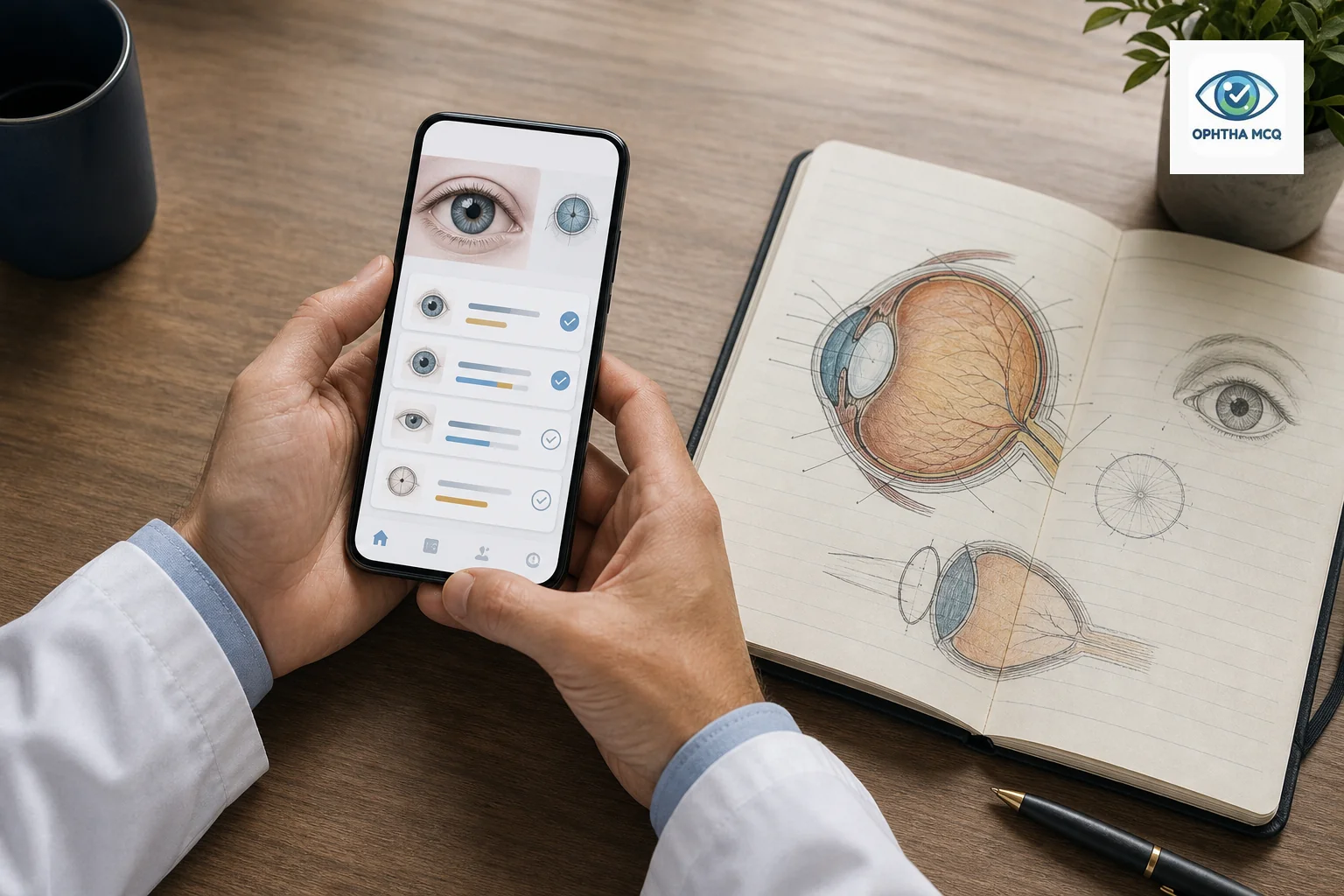
This is the same standard OphthaMCQ applies across its subspecialty content, cornea, glaucoma, retina, optics and refraction, neuro-ophthalmology, oculoplasty, paediatric ophthalmology, and pharmacology are each covered by ophthalmologists who have personally sat these exams, not generalist medical writers. If you're evaluating any resource claiming to substitute for FRCOphth past papers, ask the same question of it: who actually wrote this, and have they passed the exam themselves?
Comparing Your Options: MCQ Banks vs Textbooks vs General Platforms
Trainees without past paper access typically default to one of three study paths. Each has real trade-offs worth understanding before you commit months of revision time to it.
Textbook-only study gives you depth but not exam pattern. Reading Kanski or BCSC cover to cover builds strong clinical knowledge, but neither book is written in exam format, so you finish your reading without a clear sense of how questions will actually be phrased or which details examiners weight most heavily. Our related piece on how to use an MCQ bank for ophthalmology PG exams covers this trade-off in more detail if you're weighing textbook-first versus question-first revision.
General medical PG platforms, the kind built for broad postgraduate exam prep across multiple specialties, usually treat ophthalmology as a minor chapter rather than a full subject. Coverage of subspecialties like neuro-ophthalmology or oculoplasty tends to be thin, and explanations rarely reflect ophthalmology-specific exam conventions.
Ophthalmology-specific, syllabus-mapped MCQ banks sit closest to what an official past paper archive would offer. They're built around the actual exam structure, written by people who've faced the same viva panels and OSATs stations, and updated as curricula shift. This is the category worth prioritising when official past papers aren't an option.
The trade-off is time versus specificity: a general platform might be cheaper or already bundled with your broader PG subscription, but an ophthalmology-specific bank saves the hours you'd otherwise spend filtering out irrelevant content.
How to Use a Syllabus-Mapped MCQ Bank as Your FRCOphth Past Paper Substitute
Having the right resource matters less than how you use it. Here's a practical sequence international trainees can follow when official past papers aren't accessible.
- Start with free sample questions. Before paying for any bank, test explanation depth using free trial questions. OphthaMCQ, for instance, offers 200 free sample MCQs so you can judge writing quality and syllabus fit before committing.
- Work subspecialty by subspecialty. Rather than answering questions in random order, move through cornea, glaucoma, retina, optics and refraction, neuro-ophthalmology, oculoplasty and orbit, paediatric ophthalmology, and pharmacology in blocks. This mirrors how FRCOphth papers sample across the full curriculum and helps you spot which subspecialty needs more time.
- Simulate timed conditions regularly. Once you're comfortable with untimed practice, switch to timed exam simulations at least weekly in the two months before your sitting. Speed under pressure is exactly what past papers would have trained, so this step isn't optional.
- Pair MCQs with structured notes for weak areas. When you get a question wrong, don't just read the explanation and move on. Go back to concise, exam-ready notes on that topic, the kind distilled from Kanski, BCSC, and Ryan's Retina, to close the gap properly.
- Track and revisit flagged questions. In the final two to three weeks, revisit only the questions you previously got wrong or flagged as uncertain. This targeted review does more for recall than re-answering everything from scratch.

This workflow also applies well to trainees juggling FRCOphth alongside DNB or ICO/FICO prep, since the subspecialty structure overlaps heavily across exams. If you're balancing theory and practical prep simultaneously, our guide on prepping DNB ophthalmology theory and practicals together outlines a similar integrated approach.
What to Verify Before Trusting Any Alternative Resource
Because FRCOphth past papers can't be sourced officially in bulk, the market for "alternative" prep material is crowded, and not all of it is trustworthy. Run through this checklist before you pay for anything.
- Who wrote it? Content written by practicing ophthalmologists who've personally passed the exam carries far more weight than content from freelance medical writers or AI-generated question sets. Ask the provider directly if this isn't stated clearly.
- Is it actually mapped to your exam? A bank labelled "ophthalmology MCQs" without reference to FRCOphth, ICO/FICO, or FAICO syllabi specifically may be built for a different exam format entirely (US OKAP-style banks, for example, don't map cleanly onto FRCOphth's structure).
- Are the explanations reasoning-based or just an answer key? A correct answer without reasoning teaches memorisation, not clinical judgment, and FRCOphth increasingly tests judgment, not recall.
- How often is it refreshed? Ask about update cycles. Guideline-heavy topics like glaucoma medical therapy and retinal disease management change often enough that a bank untouched for years will teach you outdated first-line choices.
- What's the payment model? International platforms often price in USD and require a US-issued card, which locks out many trainees in the Gulf, South Asia, and Africa. Look for one-time pricing models with lifetime access instead of recurring subscriptions that assume a US billing address. Our breakdown of the UK ophthalmology trainee exam prep budget covers this cost comparison in more depth.
FRCOphth vs ICO/FICO: Does Past Paper Access Differ?
Yes, meaningfully. ICO/FICO candidates have access to a dedicated past papers archive with full explanations covering roughly the last decade of sittings, a resource OphthaMCQ built specifically because nothing comparable existed before. FRCOphth candidates don't currently have an equivalent public archive of that depth, which is precisely why syllabus-mapped MCQ practice matters more for FRCOphth prep than for ICO/FICO, where genuine past papers are within reach.
For trainees preparing for both exams, or unsure which pathway suits their career plans, a single platform covering FRCOphth, ICO/FICO, and FAICO syllabi side by side saves you from maintaining separate study systems. You can compare available content by exam directly through Browse by Exam rather than piecing together resources from multiple vendors.
Building a Practical Workflow With Limited Past Paper Access
International trainees juggling clinical duties rarely have the luxury of long, uninterrupted study blocks. The most workable routines combine short, repeatable sessions rather than depending on marathon reading sessions that clinical rotas rarely allow.
A mobile app with offline access matters more than it might seem at first. Ward rounds, on-call nights, and clinic gaps are where most international trainees actually fit in revision, and an app that works without reliable Wi-Fi turns dead time into productive study time. Pair that with lifetime PDF access to notes so you're not re-buying materials every time your subscription lapses.

Cost is the other recurring barrier. Many international question banks price at $300 or more for a six-month subscription and require a US-issued credit card, effectively excluding trainees on resident stipends in India, the Gulf, and other Commonwealth countries. A resident-friendly, one-time-payment model with lifetime access avoids both problems: no recurring charges, and no dependency on a specific currency or banking system.
If your institution is weighing bulk access for an entire resident cohort rather than individual purchases, it's worth understanding how bulk licensing pricing for eye hospitals works for resident training before every trainee buys separately.
Frequently Asked Questions
Are official FRCOphth past papers available for free?
No. The Royal College of Ophthalmologists does not publish a free, complete archive of past FRCOphth Part 1 or Part 2 papers with explanations, largely because it reuses and refines question pools across sittings for exam security. Anything claiming to be a leaked or shared "full past paper" set should be treated with caution regarding both accuracy and copyright.
Is an MCQ bank a good substitute for FRCOphth past papers?
A syllabus-mapped, ophthalmology-specific MCQ bank with detailed explanations is currently the closest available substitute. It won't be identical to an official past paper, but a well-built bank replicates the question style, difficulty level, and curriculum coverage closely enough to be genuinely useful for revision.
How do I know if an alternative resource is exam-accurate?
Check three things: who wrote the explanations (practicing ophthalmologists who've passed the exam versus generic writers), whether it's mapped explicitly to your exam's syllabus, and how recently it was updated. Testing a set of free sample questions before paying is the fastest way to judge this yourself.
Can one platform cover both FRCOphth and ICO/FICO or FAICO prep?
Yes, trainees preparing for multiple international ophthalmology exams benefit from a single platform that maps content to each syllabus separately rather than juggling different vendors for each exam. This also helps if your exam plans shift, since overlapping subspecialty content (cornea, glaucoma, retina, optics) transfers across FRCOphth, ICO/FICO, and FAICO preparation.
If official FRCOphth past papers aren't within reach, don't let that gap stall your preparation. Test the quality of a genuinely ophthalmology-specific question bank for yourself with 200 free MCQs, then explore the full range of syllabus-mapped notes and question banks by clicking through to Browse Notes & MCQs. If you're preparing for an exam not yet listed, join the waitlist to get notified when it launches, or contact us with questions about which resource fits your specific exam pathway.
Ready to apply what you learned?
Practice 10,000+ MCQs with detailed explanations and track your progress.
Start Free Practice