Why Downloadable PDF Notes for Ophthalmology Residents Support Night Duty Study

At 2 a.m. in a casualty ward with one bar of signal, a streaming-dependent app is useless. Downloadable PDF notes for ophthalmology residents solve this by living on the phone itself, so a resident can open a cornea topic or run a quick MCQ set between admissions without waiting for a page to load. That single difference, offline versus online, decides whether night duty becomes wasted hours or genuine revision time.
Key Takeaways
- Offline by design: PDFs downloaded once stay on the device, removing dependency on hospital Wi-Fi or mobile data during casualty and on-call shifts.
- Built for short windows: Handwritten, exam-mapped notes are structured so a resident can complete a topic in the 10-15 minutes typically available between calls, not in a single uninterrupted sitting.
- Two-layer system works best: Reading a PDF section and then testing it with matching offline MCQs mirrors how OSCE and viva examiners actually assess applied knowledge.
- Lifetime access matters: Notes downloaded once remain usable across rotations, repeat attempts, and even after Wi-Fi-dependent subscriptions expire.
- Structure beats volume: Organizing PDFs by exam (DNB, FAICO, ICO/FICO, FRCOphth) and subspecialty saves the re-reading time that unsorted textbook chapters waste.
At a Glance: Night-Duty Study Options Compared
| Study Method | Works Without Internet | Time to Find Relevant Content | Suited to 10-15 Min Windows | OSCE/Viva Relevance |
|---|---|---|---|---|
| Standard textbook (Kanski, Ryan Retina) | Yes (physical copy) | Slow — must locate topic in 800-900 pages | Poor — long unbroken chapters | Limited, theory-heavy |
| Generic streaming MCQ app | No, needs live connection | Fast if online | Unreliable, breaks mid-session offline | Variable, often not exam-mapped |
| Photocopied handwritten notes (paper) | Yes | Fast if well organized | Good | Depends on source quality |
| Downloadable PDF notes + offline MCQ app | Yes, fully offline after download | Fast, topic and syllabus mapped | Strong, built in short, focused sections | High when paired with OSCE-specific content |
The pattern is consistent across almost every specialty exam prep discussion: the format that survives night duty is the one that does not need a live connection and does not demand long, uninterrupted reading blocks. That is precisely the gap downloadable PDF notes are meant to close.
1. Why Night Duty Breaks a Textbook-Based Study Plan
Night duty in an eye casualty rarely follows a schedule. A resident might get forty uninterrupted minutes, or they might get called for a corneal foreign body, then a sudden vision loss case, then a referral from the emergency department, all within the same hour. Any study plan built around long reading sessions collapses the moment that rhythm starts.
Standard references like Kanski's Clinical Ophthalmology or Ryan Retina were written as comprehensive clinical texts, not exam-day revision tools. Flipping to the right page mid-shift, then finding the specific exam-relevant paragraph inside a dense chapter, eats into the very minutes a resident was hoping to use for actual studying. By the time the useful section is found, the pager often goes off again.
Connectivity compounds the problem. Many hospital on-call rooms, casualty corners, and basement duty stations have patchy or no Wi-Fi. An app that needs to stream content or verify a login online will simply fail at the exact moment a resident finally has downtime. This is one reason structured MCQ banks built for ophthalmology PG exams only help if they also work without a live connection.
2. What Makes a PDF Note "Night-Duty Ready"
Not every PDF is equally useful at 3 a.m. A scanned textbook chapter saved as a PDF is still a scanned textbook chapter: long, unfiltered, and hard to scan visually in dim light. Notes built specifically for exam revision look different on purpose.
Exam-ready PDF notes for ophthalmology residents are typically handwritten or hand-drawn in style, distilling material from standard references like Kanski, Ryan Retina, Elkington, BCSC, and Khurana into a condensed, diagram-heavy format. Instead of paragraphs of prose, a resident sees flowcharts for glaucoma classification, labelled diagrams of IOL power calculation steps, or a boxed comparison of anterior versus posterior uveitis, the kind of visual shorthand that is quick to absorb even when tired.
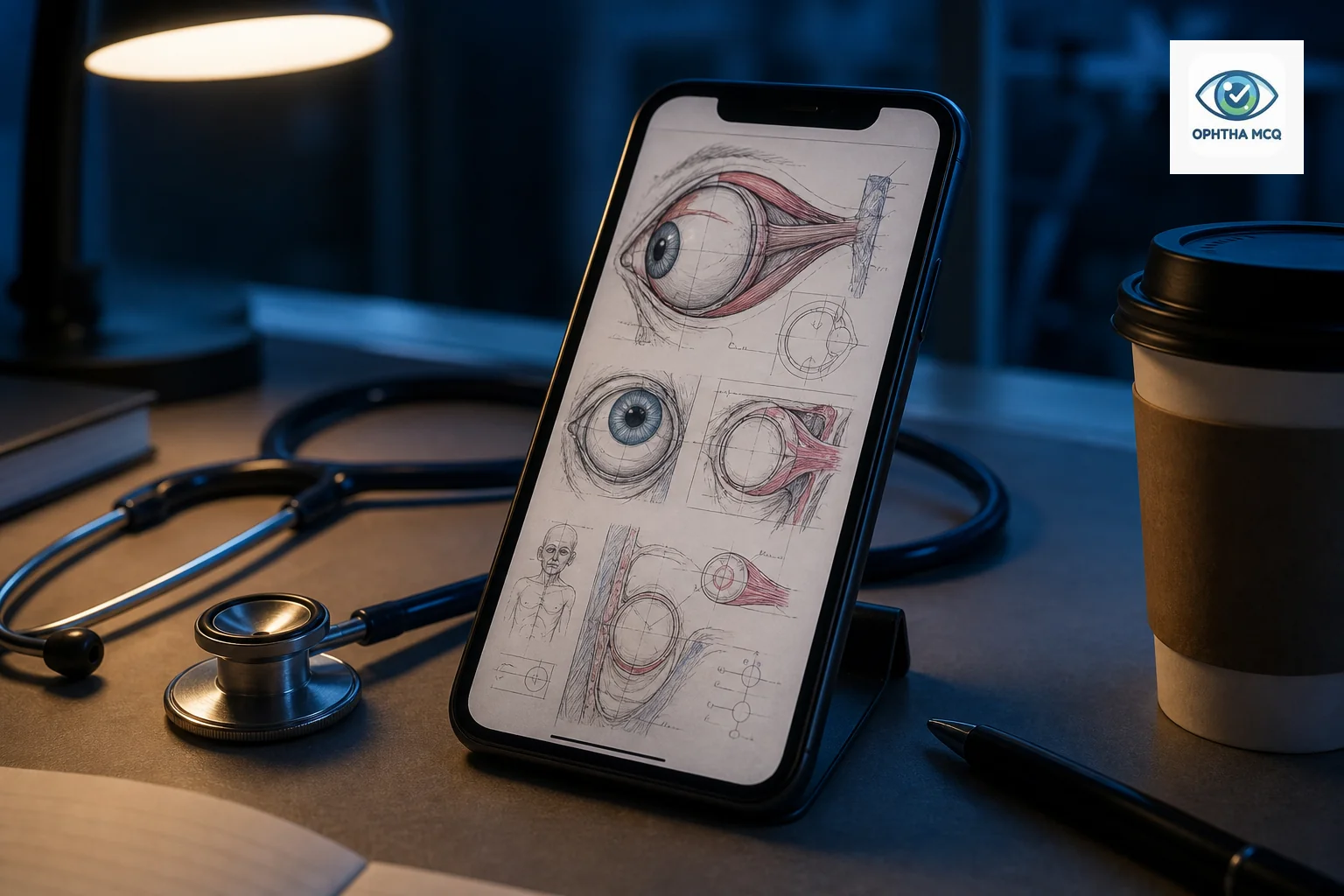
Three features separate a genuinely night-duty-ready PDF from an ordinary scanned document:
- One-time download, lifetime use: Once saved to a phone or tablet, the file opens instantly with zero data usage, whether the resident is in a Faraday-caged basement ward or a rural district hospital with unreliable towers.
- Topic-level segmentation: Notes split by subspecialty and sub-topic (say, "angle closure glaucoma" as its own short section) mean a resident can complete one self-contained unit in a single break, rather than stopping mid-chapter.
- Legibility on small screens: Diagrams and handwriting designed for phone-sized viewing, with enough contrast to read under a dim ward light without needing to zoom repeatedly.
This is the same principle behind why preparing DNB theory and practicals together works better than treating them as separate tracks: focused, exam-mapped material lets residents make progress in the fragmented time clinical duty actually allows, instead of waiting for a mythical free weekend that rarely arrives during residency.
3. Building a Portable Study System: PDFs and MCQs Together
Reading notes alone rarely survives contact with an OSCE station or a viva table. Examiners test whether a resident can apply a concept under pressure, not whether they can recite a paragraph. That is why pairing downloadable PDF notes with an ophthalmology MCQ bank built for PG exams creates a stronger system than either resource alone.
The workflow is simple in practice. A resident reads the PDF section on, say, cataract grading and IOL power formulas during a quiet stretch of night duty. Immediately after, they attempt a short set of matching MCQs, ideally using an offline-capable exam app with exam-pattern questions that doesn't require signal to load. Getting a question wrong sends them straight back to the exact PDF page, closing the loop within minutes rather than days.
This read-then-test cycle does two things a textbook alone cannot:
- It forces active recall, which retains information far better than passive re-reading, a finding well established in general medical education research on spaced retrieval practice.
- It exposes gaps immediately, while the topic is still fresh, instead of waiting until a full-length mock exam weeks later reveals the same weak area.
Residents preparing for practical components benefit even more from this pairing. DNB ophthalmology candidates studying theory and practicals together often use night-duty downtime for the theory PDF and MCQ cycle, then reserve daytime hours with better lighting and access to instruments for OSCE station rehearsal, treating the two as complementary rather than sequential.
4. Organizing PDF Notes by Exam and Subspecialty
Not all ophthalmology PG exams weight topics the same way. DNB/MS/DO practicals in India place heavy emphasis on OSCE stations, instrument identification, and case presentation. FAICO fellowship exams go deeper into a single subspecialty. ICO/FICO and FRCOphth follow international syllabi with their own past-paper patterns. A resident preparing for more than one of these, which is common among international trainees and post-MS candidates chasing subspecialty fellowships, needs PDF notes organized to match, not a single undifferentiated pile of files.
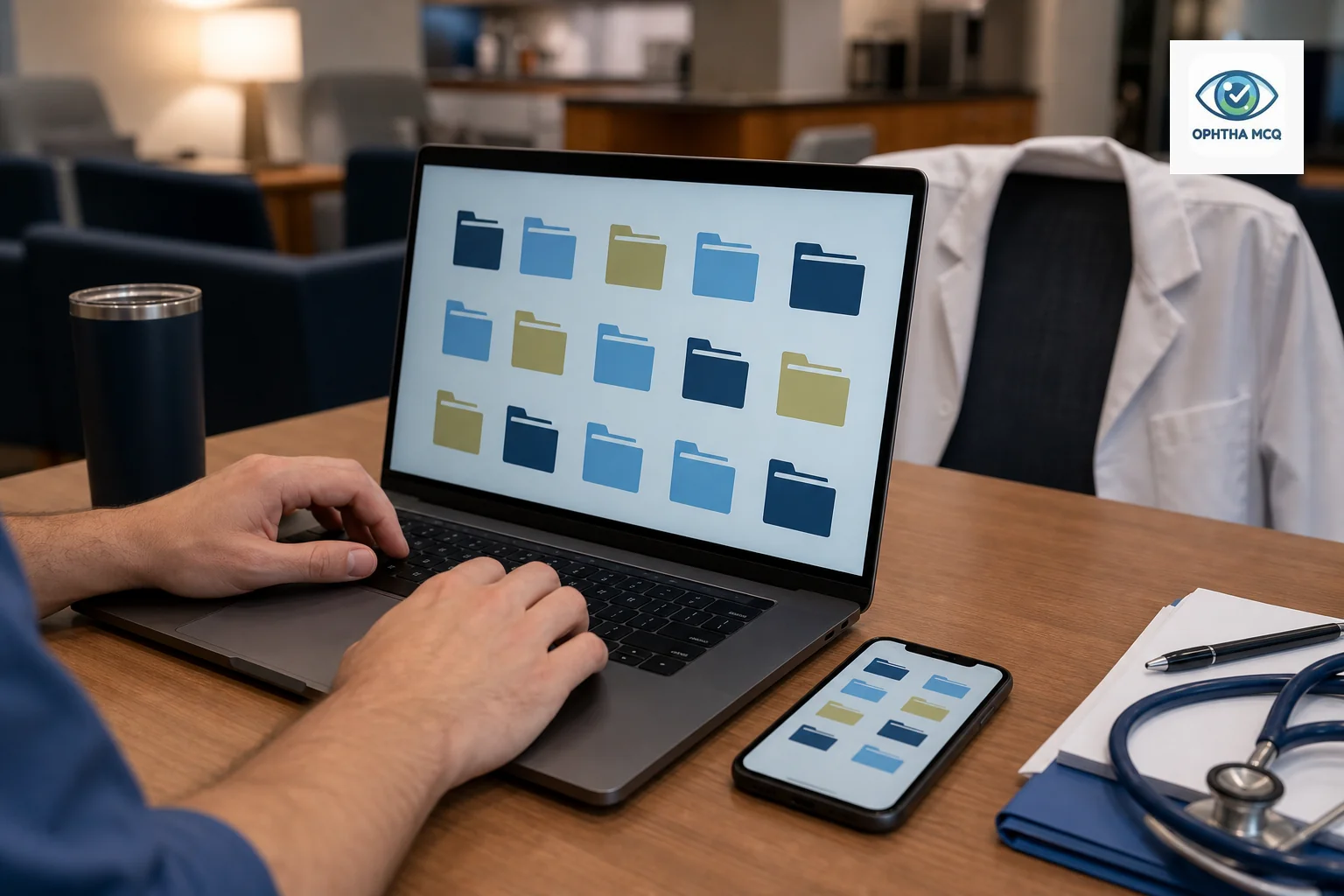
A practical folder structure that residents commonly find useful looks like this:
- By subspecialty: Cornea & external disease, glaucoma, retina & vitreo-retinal surgery, cataract/lens/IOL, optics & refraction, neuro-ophthalmology, oculoplasty & orbit, paediatric ophthalmology & squint, ocular pharmacology, investigations & imaging, and ophthalmic instruments.
- By exam: A separate view or tag for DNB/MS, FAICO, ICO/FICO, and FRCOphth, since the same cataract topic might need a different depth of detail depending on which exam is next on the calendar.
- By exam stage: Theory-focused notes kept apart from OSCE/practical/viva-oriented material, so a resident three weeks from a practical exam can filter out theory-only content and focus purely on station-relevant notes.
This kind of structure also solves a subtler problem: cross-referencing. A resident revising glaucoma OSCE stations benefits from having the matching theory PDF a tap away, instead of searching a separate app or a different textbook entirely. Subspecialty-organized notes for cataract and lens topics, for instance, work best when they sit next to the OSCE station list for that same subspecialty, since practical exams frequently test the theory a resident just reviewed in a completely different format, on a live patient or a specimen at a table.
International candidates juggling ICO/FICO alongside a home-country exam, a common situation for UK and Gulf-based ophthalmology trainees managing a tight prep budget, benefit especially from this organization, since it avoids paying twice for overlapping content and re-reading the same cornea chapter under two different labels.
5. A Night-Duty Revision Routine You Can Actually Follow
A workable routine has to survive an unpredictable shift, not assume a quiet one. Here is a structure many residents adapt to their own rotation pattern:
- Download before the shift starts. Save the subspecialty PDF and matching MCQ set to the device while still on hospital Wi-Fi or home broadband, so nothing needs to load once the shift begins.
- Pick one self-contained topic, not a whole subspecialty. Choosing "central serous chorioretinopathy" rather than "all of retina" makes it realistic to finish the unit even if interrupted twice.
- Set a small MCQ target, not a time target. Ten questions completed is a better goal on call than "study for an hour," since call rooms rarely allow an uninterrupted hour.
- Flag, don't fix, mistakes overnight. Mark wrong answers for review rather than trying to fully resolve every doubt at 3 a.m. when clinical judgment is also tired.
- Review flagged items the next morning. A 15-minute post-shift review, ideally with the PDF open to the exact page, closes the loop while the case that triggered the question is still memorable.
A few practical habits make this easier to sustain. Reduce screen brightness to protect night vision and battery life during long shifts. Download several topics at once during a rare stretch of good connectivity, so a slow week doesn't leave the resident without material. And keep the PDF viewer app itself lightweight, since a resident should not need to fight a slow-loading interface on top of an already exhausting shift.
The residents who make the most progress on call are rarely the ones studying the longest. They are the ones who never lose momentum, because their material is already on the device and already broken into pieces small enough to finish.
6. Common Mistakes Residents Make With PDF Notes on Call
Downloading the right material solves half the problem. How it gets used determines the rest. Three mistakes come up often enough to be worth naming directly.
Downloading everything, revisiting nothing. It's tempting to save every available PDF the day a subscription starts. Without a plan for which topic comes first, most residents end up re-opening the same one or two familiar files and never touching the rest until exams are uncomfortably close.
Reading without testing. Notes feel productive to read, and recognition (nodding along, "yes, I know this") feels like mastery. It isn't. Without immediate MCQ testing, most residents overestimate how much they will recall three weeks later during the actual exam. This is the exact gap covered in depth in the comparison of using an MCQ bank properly for ophthalmology PG exams rather than relying on passive review alone.
Treating theory PDFs as sufficient for practicals. Night-duty PDF study covers theory well, but OSCE stations, instrument handling, and viva questions test something different: applied, live-response knowledge. Residents who only ever revise theory PDFs on call often find the transition to practical exam readiness harder than expected. Building both tracks together, rather than assuming one covers the other, tends to produce steadier results, a point covered further in how DNB candidates can prepare theory and practicals in parallel.
FAQs on Downloadable PDF Notes for Ophthalmology Residents
Are downloadable PDF notes enough without reading the full textbook?
For most exam preparation, well-distilled PDF notes covering Kanski, Ryan Retina, Elkington, and BCSC content are sufficient for the bulk of revision, since they are built specifically around what exams actually test. A textbook remains useful as a deeper reference for unusual cases or genuine conceptual gaps, but residents rarely have time to re-read 900 pages cover to cover during residency, which is exactly the problem exam-distilled notes are designed to solve.
Do downloaded PDFs expire, or do I need to re-download them every rotation?
This depends on the licensing model. Notes purchased with lifetime access remain usable indefinitely on the device once downloaded, including across rotations, hospitals, and repeat exam attempts, without needing a fresh internet connection or re-purchase.
Can PDF notes help with OSCE and viva voce prep, not just theory?
Yes, provided the notes are organized to include OSCE-relevant content such as instrument identification, case presentation structure, and investigation interpretation, not only theory paragraphs. Pairing subspecialty PDF notes with a dedicated practical and OSCE preparation resource tends to work better than relying on theory notes alone for the practical component.
Do international trainees get the same offline PDF access as residents in India?
Yes. Since the files are downloaded once and stored locally, they work identically for a DNB candidate in a district hospital in India, an FRCOphth trainee in the UK, or a FICO candidate in the Gulf, all reviewed in more detail in the breakdown of affordable exam prep options for UK-based trainees. Connectivity in the local hospital has no bearing on whether the downloaded file opens.
How should institutions think about PDF access for resident cohorts?
Residency programs and eye hospitals managing multiple trainees often prefer a shared licensing arrangement rather than individual purchases, particularly when several residents rotate through the same night-duty roster and would benefit from consistent, syllabus-mapped material. The mechanics of this are covered in the guide to how bulk licensing pricing works for eye hospitals.
Night duty will always be unpredictable. What a resident studies during it does not have to be. Downloadable PDF notes for ophthalmology residents, organized by subspecialty and paired with an offline MCQ system, turn scattered fifteen-minute windows into consistent, exam-relevant progress instead of lost hours waiting for a signal bar to appear. If your current study material only works when the hospital Wi-Fi cooperates, it is worth testing a system that doesn't depend on it at all. Try 200 free MCQs to see how the format works before committing, or go straight to browse the full library of notes and MCQs mapped to DNB, FAICO, ICO/FICO, and FRCOphth syllabi. Residency programs evaluating options for an entire cohort can also contact the team to discuss institutional access.
Ready to apply what you learned?
Practice 10,000+ MCQs with detailed explanations and track your progress.
Start Free Practice